I am out of the closet (or should that be the crypt?) as a self-proclaimed taphophile. Graveyards have long held a fascination for me and many hours over my fifty plus years have been spent in cemeteries both here in the United Kingdom and across Europe.

On occasion, on my forays into these tranquil spaces, a particular grave will pique my curiosity. This may be for a variety of reasons, an association with local history, an intriguing epitaph or a family connection.... it doesn't take much. The online availability of censuses, official registries and newspaper archives have in recent years made it possible to learn something more about the lives lived by those remembered only as fading names carved in stone. These resources provide an opportunity to put 'flesh on old bones' as the turn of phrase goes, hence the title of this blog 'Beyond the Grave'.

If anyone reading these posts has anything to add please feel free to contact me at adrianandrews@myyahoo.com.

Wednesday, 4 September 2024

A Morning In Manchester’s Southern Cemetery


Located three miles to the south of Manchester City Centre, the magnificent Southern Cemetery is the largest municipal cemetery in the United Kingdom and the second largest in all of Europe. Over the last four years in which time our daughter was a student at the Manchester School of Art we have driven past the cemetery en route to the centre. On those occasions I could only wonder at the place as the mass of aged headstones seemed keep pace with the car for an eternity. It was, from the first time I saw it, high on my list of desirable cemetery visits.

Mo  completed her Fine Arts degree this summer (with an MA commencing this September). Time had come to leave the hustle, bustle and buzz of central Manchester and move out to more affordable accommodation in Burnage (Gallagher territory). Thus on the occasion of our most recent visit to the city Gunta and I opted to stay in nearby Didsbury rather than in Princess Street in the centre which has been our usual area to stay.

Friday morning saw weather that would be perfect in any corner of the country, let alone Manchester, the sun shining in a cloudless sky in that unique late summer/early autumn way. The kind of weather that sets a cemetery off like no other. Now, our daughter’s boyfriend, John, has a personal connection with the cemetery (as do half the residents of Manchester to be honest given its scale). His Mother and paternal Grandparents lie in the grounds and so we purchased a plant in one of the several florists whose trade is supported by Southern Cemetery. 

It sounds like a very strange thing to say about a cemetery, but I felt that there was something about this place that celebrated life. Unlike many large cemeteries in towns and cities where the development of the area can understood by looking at the age of the graves in a given area, in Southern Cemetery there is much more of a feeling that modern headstones are in close proximity with the older ones. As such there are not large swathes of the site that are untended and unvisited. As mentioned, it was a Friday morning and I would describe the place as busy, very peaceful but well, yes, busy. As we passed the North Chapel, a funeral service was in progress. Elsewhere, would be mourners were frantically trying to establish the whereabouts of other funerals taking place that morning, having in all likelihood underestimated the enormity of the site. We saw families in good spirits carrying balloons en route to the grave of a young relative. Really, in this place of death and remembrance there was evidence of life abundant. In this spirit, recognising that bereavement affects both young and old, within the grounds are post boxes  for letters to heaven and letters to the angels for children to post. There are also children’s trails through the cemetery and even traces of humour if you know where to look!

All of these things to my mind are perfectly designed to make the cemetery, if not a joyful place, far less of a place of doom, gloom and unconquerable sadness.

Another thing that struck me about Southern Cemetery was its modesty. Manchester’s first millionaire, business man and philanthropist, John Rylands has the biggest memorial in the cemetery. Indeed it is quite large, but in comparison with some of the memorials that grace the garden cemeteries of London it is not so showy at all. Legendary Manchester United manager, Sir Matt Busby, lies a bounce of a football away from John’s family’s plot. As can be seen from the photo, his headstone includes his family only and makes no reference to football at all. Contrast this with memorials in Germany, where the grave’s occupant’s worldly achievements are commonly spelled out like a curriculum vitae in stone for any passer to see!

Another notable resident is the painter L.S. Lowery. Such an understated memorial. He is commemorated on a side panel of his parents' grave with just mention of his name and dates. The only clue to his illustrious past and fame is a small collection of worn and weathered paint brushes left by admirers of the man and his work.

It doesn't take much for me to recommend a visit to most cemeteries, but this one is truely exceptional. Walk its paths and who knows you may even see Morrissey. The Smiths' track, 'Cemetery Gates' is widely believed to be based upon times he spent within the grounds.


Tuesday, 28 May 2024

Vesuvius - The Volcano What Done It in AD79!


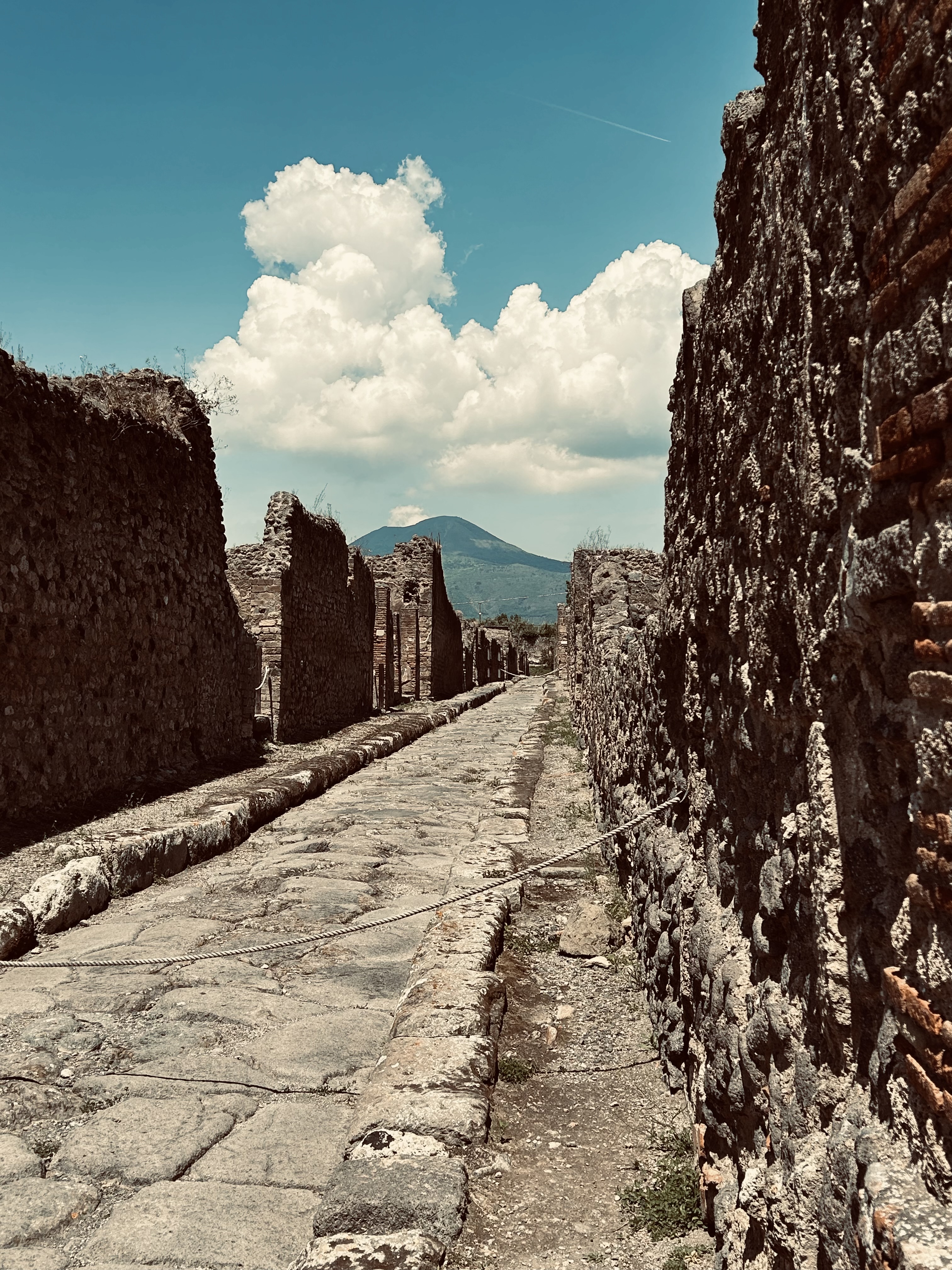
Above is Mount Vesuvius viewed from the excavated ruins of Pompeii. Any trip to the Bay of Naples area involves Vesuvius, even if only as a view. On Day 2 of our time recently in Sorrento, as a base for visits to Pompeii and Herculaneum, the party had a day with nothing scheduled. So this became the opportunity to pay a visit to the volcano's crater.

Mount Vesuvius viewed from Sorrento

Picking up a minibus from Pompeii Scavi-Villa dei Misteri, the train station that serves the ruins I admired and was horrified in equal measure by the driver's skills as he maneuvered the packed vehicle ever upwards on the slopes of Vesuvius. It helped in no way that, with my well developed fear of heights, I was on the side of the bus with the most dramatic view of the perilous drop down the side of the mountain that my window seat offered!

Nevertheless, we made it to the point where the buses disgorged their tourists and left them to make their way to the rim of the crater on foot. The literature states that the climb is only 1.8 metres but whilst manageable it wasn't exactly a walk in the park.

The upward journey offered marvelous views across the Bay of Naples. 

I was surprised to find that the air was free from the smell of sulphur. In my albeit limited experience of climbing volcanoes (Mount Teide in Tenerife in 1982!) even dormant volcanoes show off a lot of sulphur and associated odours! No such problems on the crater's edge on Vesuvius.


Panoramic view of the crater

In terms of thermal activity there were no more than a few wisps of steam just visible around some of the rocks. But to peer into the void is like looking at a vision of Tolkien's creation of Mordor! It is definitely a place in which to feel wholly insignificant in the face of the full force of nature. Just think that Prior to the eruption in AD59 Vesuvius was no less than 600 meters higher than it is today and consider the statistic that I mentioned in the earlier Pompeii post, that at the height of the eruption, the volcano was ejecting an estimated 1.5 million tonnes of material per second! I find those facts very intimidating. 


We spent about an hour walking around the area of the rim that is accessible to the public   (approximately half of the perimeter by my reckoning) before making the descent back to the car park area and our daredevil bus driver. The way down was a little more perilous as the pumice on the path had a tendency to take your feet from under you. 

This chap though had it all sussed!


Vesuvius is safe for now. Monitoring stations are clearly visible around the crater. We were told as long as Sicily's Mount Etna continued to perform, Vesuvius will remain quiet. However, if the Etna's seismic activity tailed off the folk in and around the Bay of Naples would need to take heed! 


Pompeii 13th May 2024 - A Roman Tragedy That Became A Gift For The World


The eruption of Vesuvius in AD79 was cataclysmic for the inhabitants of the commercial hub city of Pompeii (residents of Herculaneum on another slope of the volcano faired no better). Mount Vesuvius dominates the Bay of Naples in the Campania region of Southern Italy.

One fateful afternoon in the Autumn of AD79, one of the most famous and deadly volcanic events commenced in an eruption that lasted for two days and consisted of distinct and different phases that radically distinguish the two destroyed cities of Pompeii and Herculaneum. The first eruption occured at 1pm (according to the account of Pliny the Younger, a witness from the other side of the bay) and lasted 18 hours. This first phase of the eruption ejected a column of pumice, ash and molten rock a staggering 33 kilometers into the air. It is estimated that 1.5 million tonnes of material were spewed into the atmosphere per second. Day turned into night and violent electrical storms raged in the vicinity of the volcano. After many hours the ferocity of the eruption tailed off such that the airborne material was now longer supported, gravity played its part and down the debris came... and a lot of it too!

A layer of pumice and ash was deposited upon the city of Pompeii to an estimated depth of 2.8 meters. Many citizens perished in this first phase. Those that survived the collapse of the ash and pumice column having found adequate shelter in sound buildings believed, mistakenly, that for them the worst was over.

On the second day of the eruption a second event occurred that was very different in nature and significantly more lethal and inescapable. Today, volcanologists understand the anatomy of volcanos and the different ways in which they behave. This was not knowledge enjoyed by the Roman population of the doomed settlements constructed on the lower slopes of Vesuvius. In the second event Pompeii was hit by two pyroclastic surges (fast moving flows of superheated gases and molten rock). This surge advanced down the slope towards Pompeii at a speed in excess of 100 mph, incinerating all upon contact. Any survivors of the first stage of the eruption died as a result of thermal shock as the surge engulfed the city. 

This pyroclastic surge laid down a further layer of volcanic material that marked the end of Pompeii's long history. The city then remained buried, encased in a tephra tomb for a millennia and a half until findings were made in the 1500's. However, formal excavations on the site did not commence in earnest until the 1800's when ancient cultures and the archaeology of their cities became a popular pursuit with digs funded by the wealth of the west.

With 'modern' archaeological investigations underway, it soon became apparent that human and animal remains lay under the pumice. Those victims of the eruption, having succumbed to asphyxiation in the first phase or the thermal shock of the second phase died quickly where they lay in the positions they were in at the point of their death. We know this thanks to the pioneering technique developed by Giuseppe Fiorelli in the 1800's that was capable of preserving the remains of victims in their 'point of death' positions.

The bodies of victims killed as described above were rapidly buried by the pumice. Trapped oxygen in the volcanic material allowed the normal process of organic matter decay to occur leaving skeletal remains in position, surrounded by voids previously occupied by soft tissue. When probing of the area from the surface indicated the presence of a void, plaster was poured into holes from above, thereby filling any cavities and encasing the skeletons once more. Then, removal of the surrounding pumice revealed a cast of the body as it was at the exact moment of death.


Several such casts are on display in the Antiquarium on site and they are very poignant still, almost 2,000 years later.

The first example of a cast to greet the visitor is one guaranteed to tug at the heart strings of a predominantly British party... a nation of animal lovers... yes indeed.


The cast accurately shows a dog in its death throes. Detail is visible on the cast of the chain that secured the animal to its tethering which made escape impossible. The same fate befell many others on that day, over two thousand bodies of humans and animals. Putting our love of animals aside for a moment, the first rooms of the museum at Pompeii pull no punches with real human tragedies captured in heartbreaking detail. The futile efforts of fathers trying to protect infants and even a clearly pregnant woman in death.


The nature of the casting process is such that the last moments of these victims of the volcano are so much more relatable that those of individuals whose remains have passed down through history as disarticulated skeletons in a grave plot. The panic and pain are tangible in these casts and it is near impossible not to feel some connection despite the passage of two millennia.

Whilst the casts are a very graphic reminder of the fact that this was the site of a real human tragedy on a colossal scale, the site of Pompeii offers us so much more as well. In the title of this post, I mentioned that this was a tragedy that was at the same time a gift for the world and I really believe that to be the case. Pompeii and Herculaneum offer a unique insight into every day Roman culture from the super wealthy traders in their grand houses right down to the slaves that endured terrible working conditions to make bread for the population of the city. It really is all here in often very mundane but magnificently preserved detail. I cannot for the life of me imagine getting enthralled by the discovery of the first Kentucky Fried Chicken outlet, but show me the Roman equivalent and I can be bowled over!

The photograph below shows just such a fast food outlet in an AD79 style. Holes in the work surfaces would have contained vessels containing soups and stews where citizens going about their daily business would have stopped for lunch, rather than returning to the family home, i.e. in exactly the same way that people work in towns and cities today. 


As a write this we in the UK are five weeks away from a General Election and election fever and all of the incumbent nonsense that such an event entails is upon us. Thus it was for the Romans as well. The museum houses an early campaign wall painting promoting a candidate.


Electoral slogans by those seeking power and influence in Pompeii competed for wall space with political protest... again a distant echo of the situation that prevails in urban areas today.

At this point I cannot but be reminded of a scene of protest from Python's 'Life of Brian'!

'Romani ite domum'

In terms of domesticity and the routine of daily life the baths are something to be held too. The sophistication of the engineering that enabled the construction of the baths, social hubs of their day, such that users had access to a progression from hot room (Calidarium), to the warm room (Tepidarium) and finally the cold room for refreshment (Frigidarium) is still a marvel. The decor in these communal buildings is also phenomenal. As seen from these images from one of the city's baths for women.


One last word on Pompeii. Shortly before our visit, the BBC screened a three part documentary focused on some recent, very significant excavations at the site (Pompeii: The New Dig). As well as unearthing some tremendous finds which again shed light on the social structure of this most successful of Roman cities, the series also postulated a new (at least to me) theory about the fate of the inhabitants.

Many of the roads in Pompeii are scarred with deep furrows in the massive cobbles created by the passage of cart wheels over centuries (see below).

Cart wheel grooves can be seen across the centre of the photo.

An idea has been put forward that given this reliance on horse and cart to transport goods throughout the bustling city if the eruption of Vesuvius killed every man and beast in the city why have the remains of so few horses and carts been uncovered to date (and why have only a couple of thousand bodies been discovered in a city of an estimated 20-20 thousand when 70 percent of the site has been subject to excavation?) This leads to the theory that more inhabitants were able to flee the city to create new post-eruption lives in Naples.

I am sure that Pompeii will keep on offering gifts of understanding as to the lives of the ancient Romans for centuries to come. It's well worth seeking out on iPlayer.

One last photo... I know, trying to be arty with an iphone!

A view along one of the main thoroughfares with Vesuvius looming in the background. It just so happened that a cloud formation was above the volcano.... but it looks good!


Friday, 15 September 2023

Remembering J.E.R. Young and C. C. Taylor 37 (Home Defence) Squadron, Royal Flying Corps Killed in Action on 7th July 1917

As mentioned in the previous post, two airmen of 37 (HD) Squadron were killed in action against the enemy. Second Lieutenant John Edward Rostron Young and Air Mechanic Second Class Cyril Charles Taylor lost their lives when engaging a large force of Gotha bombers during a daylight raid on Saturday 7th July 1917. Both men died in the same aircraft, a Sopwith 1 1/2 Strutter 2-seater. Taylor was the observer and Young the pilot. This aircraft was one of many that were sent up from several aerodromes across Essex and Kent (nearly 100 machines were reported were reported as attempting to engage the enemy aircraft). Planes from all three sections of 37 (HD) Squadron (A Flight (Rochford), B Flight (Stow Maries) and C Flight (Goldhanger)) were airborne that morning. Young and Taylor's aircraft took of from Rochford on the fateful morning.

The raiders on that day consisted of 22 Gotha bombers, a huge force participating in a second attack on the capital. 

A Gotha heavy bomber

The fate of the two young airmen's Sopwith is described in the following contemporary newspaper report that appeared in the 13th July 1917 edition of the Streatham News, Balham and Tooting News and Borough of Wandsworth Chronicle.

What rather surprised me about this account was the level of detail provided to the father of the pilot, John Young, that alluded to the fact that at the time that his strickened aircraft plummeted into the sea, poor John's body would have been 'riddled with bullets'. My guess is that these words, provided to grieving parents, in a letter from the young officer's Commanding Officer would have been intended to convey the fact that in the face of such overwhelming enemy fire power, John Young's death would have been quick, clean and painless. That a newspaper printed such detail is perhaps more surprising given the potential negative impact that such detailed reporting could have on the readership. Note also that the reporting journalist refers to the account being that of a 'thrilling story of a young Streatham airman’s attack...'. I'd like to think that after more than a century of warfare subsequent to The Great War, modern writers would steer clear of Victor comic book style reporting. But that is just my opinion. 

Streatham News, Balham and Tooting News and Borough of Wandsworth Chronicle
13th July 1917


It is with feelings of profound and justifiable pride, tempered unfortunately by keen and sincere regret that so noble and gallant an officer should have won renown at the expense of his life, that our readers will read the following thrilling story of a young Streatham airman’s attack on a whole squadron of enemy airmen.

The Spartan fortitude and unselfish patriotism with which the sorely bereaved father of so heroic a son has braced himself to pen a modest tribute to his boy, and at the same time a brave and inspiriting message of emulation, will, we are sure, make a strong appeal to the sympathy and respect of all who read his introductory letter as follows:-

SIR, - At a time like the present, when the feeling of insecurity and indignation regarding our foul enemy and his infernal methods runs strong in the City and elsewhere, the circumstances attending the death last Saturday, the 7th inst., of my dear son, 2nd Lieut. John E. R. Young, R.F.C., in the performance of his duty, will be read with interest and – speaking for myself at any rate – with profound gratitude. The enclosed letter I received today from the Commander of his squadron, entirely unsolicited, will serve to assure us all that our splendid boys, who from their point of view have the privilege, have also the will and the pluck to put up noble efforts for our protection and for the defeat of the vilest enemy in all history.

Many other equally brave boys have been taken from this district, and I should not intrude upon the public with a personal letter regarding my poor son were it not that I think that it will be appreciated and do good at this time. Believing, as I do, that we have lots of the same material, and that my son was just one of many willing to face certain death in order to help stamp out the enemies of civilization, the subjoined letter from my son’s commander may help to inspire confidence and the hope that our defences will soon be complete and the enemy’s atrocious methods frustrated. – Your, etc..

W. S. YOUNG

76 Mitcham Lane, Streatham.
July 10th, 1917

_____________________

A Town in Essex

DEAR MR YOUNG,

It is with the deepest regret and sympathy that I have to write and inform you of your son’s death, which took place on Saturday during enemy aircraft attack on this country.

Your son, as you know, had only been in my squadron a short time, but quite long enough for me to realize what a very efficient and gallant officer he was, and what a tremendous loss he is to me. He had absolutely the heart of a lion, and he was a very good pilot.

Your son has been up on every raid of late, and has always managed to get in contact with the enemy machine. The last raid, which unfortunately resulted in his death, shows what a very gallant officer we have lost. Almost single-handed he he flew straight into the middle of the 22 machines and both he and his observer at once opened fire. All the enemy machines opened fire also, so he was horribly outnumbered. The volume of fire to which he was subjected to was too awful for words. (To give you a rough idea. There were 22 machines. Each machine had four guns. Each gun was firing about 400 rounds per minute). Your son never hesitated in the slightest. He flew straight on until, as I should imagine, he must have been riddled with bullets. The machine then put its nose right up in the air and fell over and went spinning down into the sea from 14,000 feet. The machine sank so quickly that it was, I regret, impossible to save your son’s body, he was so badly entangled with wires etc. H.M.S. ___________ rushed to the spot as soon as possible but only arrived in time to pick up your son’s observer, who, I regret to state, is also dead. He was wounded six times and had a double fracture of the skull.

I cannot speak too highly of the magnificent behaviour of your son, all that I can say is that he was a most gallant officer, and I am proud to think that he was in my command. 

I hope that you and your family will accept my sincerest sympathy of all his brother officers, in your great loss. ---- Yours sincerely,

___________, Major.

Sec. Lieut. John Edward Rostron Young, who was 19 ½ years of age, was educated at Streatham Grammar School.


John is memorialised in Southend-On-Sea's (North Road) Cemetery.

(Photo: Jacqui Roberts)

'WHO WAS KILLED BY THE NORE LIGHT IN BRAVE ATTACK ON 22 RAIDING GOTHAS AND WHOSE BODY WAS NOT RECOVERED.'

But let us not forget the other 37 (HD) Squadron fatality on that day, John's observer, Air Mechanic Second Class Cyril Charles Taylor. 

I have no other newspaper references concerning the death of Cyril other than the mention the recovery of his fatally wounded body from the sea by the Royal Navy vessel. So the information that follows are the result of research by the Stow Maries' volunteers.

Cyril was born in June 1897 in the Hampstead area of North London. Prior to joining up he worked as an apprentice plumber. In uniform he served a year as a bandsman with the 3/9th Middlesex Regiment, prior to enlisting with the Royal Flying Corps on 8th March 1916. 

Although the date of his being stationed with 37 (HD) Squadron is not known it is believed that me may have been part of the unit's orchestra. As described by his Commanding Officer, Cyril's body was recovered from the crash site with terrible injuries. The recovering vessel has been identified as H.M.S. Wolfe.

Cyril's body was returned to North London and he lies in Hampstead Cemetery. Cyril was 20 years of age.

Air Mechanic Second Class Cyril Charles Taylor

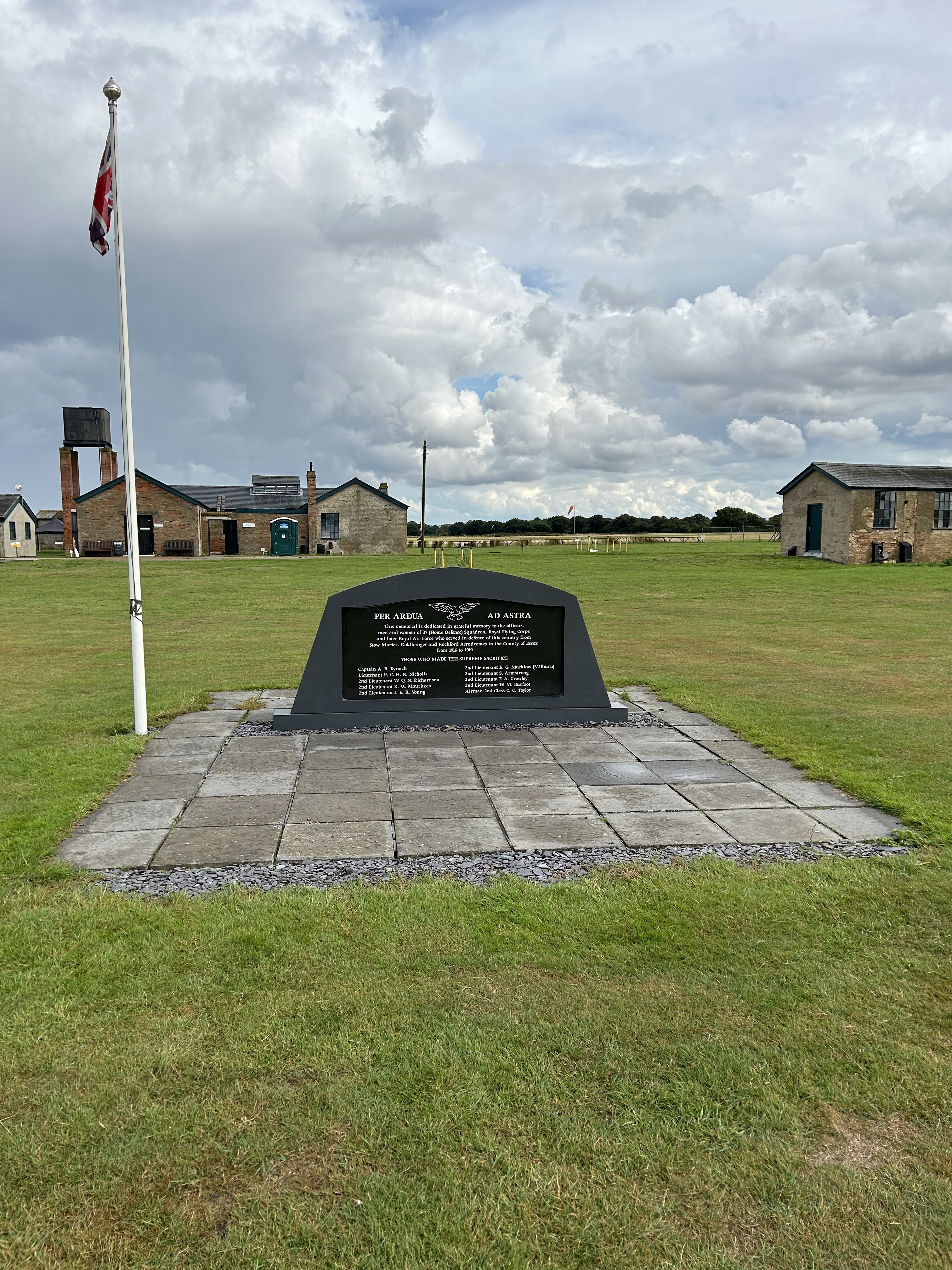
Both John and Cyril are commemorated side by side on the Stow Maries memorial to the fallen of 37 (HD) Squadron.


There is a footnote to this story that for obvious reasons was not raised at the time of Mr Young's correspondence with the Streatham News. It has been postulated that Second Lieutenant's Young's Sopwith was not downed in a hail of Gotha machine gun fire but rather by a shell fired by a Royal Navy vessel, an early example of so-called 'friendly fire'. 

A thread on the excellent The Great War (1914-1918) Forum concerning the response to the 7th July 1917 Gotha raid on London gives a number of reasons why this may be so: 
  • The Gothas were at a height of at least 14,000 feet and Young would not have attained this height until 10 to 15 minutes after the Gothas had crossed the coast (making a crash into the sea impossible).
  • No 37 (HD) Squadron personnel reported a colleague going down.
  • Young’s aircraft fell near the Maplin lightship and observers on the ship believed that it had been hit by an AA shell burst.
  • A signal of “obscure origin” amongst the day’s reports mentioned a belief that a shell had shot down a defending aircraft.
  • A 37 (HD) Squadron pilot reported that the AA fire had been a considerable hindrance.
  • The Germans reported just one defending aircraft being shot down, presumably Salmon (the other British fatality in the raid). Second Lieutenant W.G. Salmon of No. 63 Training Squadron took off in a Sopwith Scout from Dartford Aerodrome.
  • General Henderson reported to CIGS on 14 July that the RFC could not continue to take the risk of being shot down by our own guns while attacking the enemy.
With approaching 100 British fighter aircraft and 22 Gotha bombers blazing at each other, not to mention the skyward projectiles being launched from vessels below, the situation as viewed from sea level or the air must have been bewildering to say the least. 

With the passage of 105 years since this early 'dogfight' over the Essex/Kent coast it is highly unlikely that the true fate of Young's Sopwith will ever be known. But, 105 years down the line such detail is rather irrelevant, a detail in one of many thousands of Great War unknowns. The important fact that is as clear today as it was on 7th July 1917 is that the young men of 37 (HD) Squadron were prepared to tackle superior hostile airborne forces against great odds in order to protect the civilian population of London and the coastal towns of the East Coast. Many paid the ultimate price.

Tuesday, 12 September 2023

Stow Maries Great War Aerodrome - A Step Back in Time


Artists impression of the Stow Maries Aerodrome in use
(Artist: Chris French FGAvA)


My wife, Gunta, and I live on the Hertfordshire-Essex border. In fact such is the position of Bishops Stortford that we are in fact surrounded by the county of Essex on three sides, to the north, east and south. It is then perhaps surprising that having lived in the town for 29 years were are pretty ignorant about the Essex countryside (my journeys to the office in Harlow do not really count!). So it was a couple of weeks ago that we decided on an Essex day out.

The plan was simple, first a visit to the Royal Horticultural Society gardens at Hyde Hall (located close to Chelmesford). They have an annual craft fair that Gunta wanted to visit. She, knowing full well that a visit to a garden/garden centre location ran the risk of inducing in me an episode of surliness she did some further homework on the area and established that just a stone's throw from Hyde Hall is Stow Maries aerodrome and museum... a bit of Great War history to redress the balance.

The satnav app on my phone told us that the aerodrome was just four miles away from the gardens. What the phone app did not tell me, but the museums web site did... had I bothered to scroll down that far was that the directions provided by satnav take the hapless, history hungry sightseer to the wrong entrance. There followed something of a slow progress down country lanes and farm tracks until eventually we reached the correct gate and were able to park up.

A volunteer by the gate welcomed us onto the site and informed us that we were welcome to wander around under our own steam or we could take the guided tour at one o'clock. Well, since we initially were unsure of how long we would be around, we paid in and took ourselves around the exhibitions that ultimately culminated in the original Airman's mess building which has been carefully restored such that one of the pilots of 1916 would not think anything was out of place.... except perhaps for an electronic till and a card reader proffered by the lady behind the counter. It was at this point that the heaven's opened and we resolved to stay a little longer and do the tour.

For all of my interest in the First World War, the existence of Stow Maries aerodrome was unknown to me... unlike the rash of Second World War airfields that exist all around where we live, even though many of them only exist as traces and a keen eye is needed to spot the military buildings that have long been repurposed to agricultural use.

Whilst aerial warefare had precedence in many battles in antiquity, the first use of aircraft in aerial attacks was by the Italian Army Air Corps against Turkish troops in Libya in 1911. In the run up to The Great War, as Europe tied itself up in Ententes and Treaties that made war an inevitability, it was well understood by military High Commands on all sides that for the first time the experience of warfare could be brought to the civilian population of the waring nations with the explicit aim that the resulting terror and demoralisation of attacks from the skies would very likely lead to one or other side suing for peace.

Since aviation was such a new and thrilling innovation, in the immediate pre-war years the military powers that would soon be at war were keen to show of their latest flying machines, both in public displays and in military exercises. So when war came in August 1914, the British public were familiar with the massive Zeppelin and I dare say could imagine what they could do if and when they appeared over British towns and cities.

And indeed the aircraft came, not only the fearful Zeppelins but also the first dedicated bomber aircraft in the form of Gothas and Giants. The dread prophesy that the age of warfare played out on distant battlefields would be replaced by aerial bombing of civilian cities was quickly realised after the announcement of hostilities between Britain and Germany.

The British response was slow, the supposition being that any major conflict involving Britain would reach a victorious conclusion through the efforts of the Royal Navy and the superiority of the British fleet. However, within weeks it was apparent that this 'scrap' would not 'be over by Christmas' and aerial defence against German air raids had to be tackled.

Stow Maries aerodrome was established in September 1916 as part of No. 37 (Home Defense) Squadron of the Royal Flying Corps. Established as B Flight, other 37 HD squadrons were located at Roachford (A Flight) (now the site of London Southend airport) and C Flight at Goldhanger, close to Malden. The locations of these aerodrome stations was carefully considered. Placement took into account the range of the enemy aircraft and their navigational capabilities to reach their intended targets once they crossed the English coastline. At this point it is worth remembering that the task of reaching airspace over the intended target was no mean feat. The Zeppelin was essentially a 160+ meter hydrogen filled balloon that was, despite the best efforts of whatever horse power engines that propelled it, ultimately at the mercy of the weather conditions that prevailed at 20,000 feet! That said, with London as the gold medal target it was the estuaries of the rivers of Essex and Kent that provided the required navigation to the capital.

To the north Goldhanger (C Flight) protected the approach from the River Blackwater, Stow Maries (B Flight) covered the approach from the coast along the River Crouch and Roachford (A Flight) protected the approaches up the Thames estuary.

Military staff posted to Stow Maries from the late summer of 1916 were originally accommodated in canvas quarters before increasing budgets saw a progressive solidification of site constructions from canvas, through timber to the brick buildings that remain today.

The Home Defence (HD) squadrons were established in the aftermath of the public outcry that followed the Zeppelin raids over an ill-defended London and the loss of civilian life. Stow Maries HD Squadron, B Flight, Royal Flying Corps was operational between September 1916 and early 1919, when the site was decommissioned. 

For the young airmen of Stow Maries the odds were significantly stacked against them. Aviation as a phenomenon was barely in its teens in 1916. The aircraft designated for the home defence role were in relative terms both outdated and poor in performance. The aircraft manufacturers of the day produced model after model, each (usually) a slightly improved over predecessors, but these were destined for service on the Western Front... the boys attempting to stop the German bombers had to make do. Engagement with a Zeppelin (or a Gotha or Giant bomber for that matter) was fraught with practical difficulties. Detection of the enemy was the first challenge in those pre-radar days (wireless radio communication was also in its infancy during the First World War and tested out at Stow Maries in conjunction with the Marconi Company who were based in nearby Chelmesford during the aerodromes operational lifetime). With a typical ceiling altitude of 20,000 feet, Zeppelins were not visible despite their massive size, as most attacks occurred at night. With luck spotter ships located off the east coast may hear the engines and this information would be telegraphed to the War Office who in term would then alert the HD aerodromes. This inefficient chain of communication meant that it would not be unusual for more than an hour to pass from first detection of an incoming raid to a having plane in the air to try to intercept then. Which brings us onto the next problem. Pilots would have to take off into a void of blackness and then climb to get as close as possible to the incoming Zeppelins. The BE2e, a two seater observation aircraft would take 45 minutes to climb to 10,000 feet. Once at a fighting height, the pilot would either have to be almost on top of a Zeppelin to attack it or rely on the ability of searchlight  crews to pinpoint a craft in their beams.

A Zeppelin pinpointed in searchlight beams over London

Whether successful or not in an interception, the pilot would finally have to bring his aircraft back in and land successfully. This was a manoeuvre of particular danger since all of the weight of the aircraft was in the front which lead to an inherent instability and a tendency to pitch forward on landing. It is extremely telling that of the ten airmen who served at the three aerodromes of 37 (HD) Squadron, only two were killed in action, the other eight lost their lives in training. So temperamental were these aircraft and so rudimentary the training available at the time, that many inexperienced pilots were killed on take off and landing. Many suffered horrible deaths as their fuel laden aircraft would engulf them in flames upon a crash landing. 

A crashed Sopworth Pup

After decommissioning in 1919, the site returned to its original agricultural use when reacquired by the Turner family (the original owners of the site at the time that the aerodrome was established. Some of the buildings e.g. the motor transport shed was adapted for large agricultural machinery, but many of the other original aerodrome buildings were left untouched and fell into a state of disrepair over the years. Eventually, through local public funding the site was acquired in December 2013 and placed in the hands of a Charitable Trust, Stow Maries Great War Aerodrome Limited (SMGWA). Prior that, earlier subscription funding in 2010 resulted in the raising of a memorial to the men of 37 (HD) Squadron who lost their lives in the conflict. In 2012, the twenty two surviving buildings were assured further protection by having Grade II listed status conferred upon and in the same year the site was added to English Heritage's 'Buildings At Risk' register.

Stow Maries' distinctive water tower
 

The Airman's Mess

Interior of the Airman's Mess, restored to its 1917 appearance.

The Airman's Mess still serves as a place of refreshment and entertainment housing a cafe and library.

Interior of the Pilots' Ready Room

Here pilots would be briefed and await the 'Ready to Patrol' command that would send them running to their machines in order to intercept raiding aircraft.

One particularly unassuming, yet highly poignant, building is the mortuary which doubled up as an ambulance station. 

Mortuary/Ambulance Station


Above is the ammunition store, built mostly underground and covered by a thin corrugated iron roof, the idea being that in the event of an explosion, the force of the blast would be in upward direction, through the roof, thereby causing less damage to surrounding buildings and personnel.

The site has a couple of hangers (there are future plans to rebuild the hangers as they were during the war) where there can be found some forensically accurate replicas of the models of aircraft that operated out of Stow Maries.

The Royal Aircraft Factory's BE2e


The Memorial


It is all too easy when visiting a site such as Stow Maries to sample the tea and ice cream and get lost in the information panels of the exhibitions, but I took a moment away from all that and removed from others to reflect for a moment on what actually happened here. Standing in a field surrounded by these old functional buildings I looked across the flat Essex landscape then looked up at the grey clouds scudding overhead in the direction of London and thought about the young men who spent two or three years in this same field over a hundred years ago. They were so young, significantly younger now than my son, and whilst they were every bit in the mold of fighter pilots as we view them today, high spirited, eager for adventure and perhaps rather gung ho, they also died here and are remembered solemnly for their bravery and sacrifice.

If you find yourself in the Chelmesford/Malden area with a couple of hours to spare you could do a lot worse than pay the site a visit.

https://www.stowmaries.org.uk/


Sunday, 19 March 2023

Down In The Ground Where The Dead Men Go - The Catacombs of Paris March 2023


Just where does a taphophile head to for his holidays, why underground of course. The planning was perfect, an itinerary constructed with a teutonic eye for detail, baggage drop off arranged, traverses across the Metro system mapped out and guided tours booked.

The top level plan was as follows:

Paris catacombs
Pere Lachaise Cemetery ghost tour
The flea markets of Paris
The Stranglers

A full schedule for our first return to Paris since 2019, prior to the period of suspended animation, so we were determined to take in as much as possible in our short two night visit. Unfortunately, our planned tour of the cemetery was cancelled due to high winds and the associated risk of injury to the public from falling boughs.

On a positive note, nothing in the way of gales, rain, snow or plagues of frogs dropping from the sky can interfere with a tour that takes place sixty feet beneath the Parisian streets. It has long been my wish to pay a visit to one of the many catacomb complexes that exist in several European cities. A planned trip to Palermo in Sicily never materialized but Paris is a good substitute. In fact the Paris option was if anything more of a draw given the history of the site and the reasons why it was created as an ossuary.

The history is as complex as it is rich. To take it to the extreme, the history of the catacombs is to be measured on the geological timescale, when the land that Paris now occupied formed part of an ocean bed. The deposition of trillions of sea creatures on the ocean floor created over time rich seems of limestone rock. The very rock from which the city has been constructed, so-called Lutetian limestone which was extracted from the Middle Ages to 1776 when a decree ordered the closure of the quarries.

Initially, the young Parisian conurbation did not encroach upon the land undermined by the quarry chambers, since the residential area was confined to the Île-de-France. However, in time and common with all major developing cities, the footprint of Paris grew as the population mushroomed. By the 1700’s, construction had extended across the land under which the chambers and tunnels of the limestone quarries  ran. In 1774, the inevitable occurred when a significant section of Rue D’Enfer disappeared into a sink hole created as unsupported mine works collapsed. Seven residents fell eighty feet to their deaths. Paris was outraged and the quarries were closed in 1776 as a result of such instability.

The King’s State Council of Louis XVI hired an engineer, Antoine Dupont to map the quarry system and to reinforce the chambers as required to ensure that no further collapses threatened the well-being of the Parisian population.

Plaque marking the first supporting structure built in the mines. The upper stone bears the inscription 'D 1783' informing the observer that this wall was built under Antoine Dupont in 1783'.

Somewhat closer to the surface, Paris was experiencing a similar distasteful dilemma that many other European metropolises were faced with, not least London. Citizens laid great significance to being buried within the consecrated ground of the churches in which they had worshipped in life. This is of course understandable in a society far more connected to a secular way of life than we are today. However, internments in small urban churchyards over a period of hundreds of years had resulted in dramatic overcrowding. Only the wealthy could afford the luxury of burial in a single occupancy grave plot. For the majority eternal rest was something that had to be spent in close proximity with many others! The burial practice of the day meant that mass graves would remain open until such time that there were sufficient corpses interred to fill the space available and this could be a matter of weeks for each communal plot. This situation was much to the detriment of the local population who lived cheek by jowl with their departed relatives and friends.

The problem that the living had to contend with does not require too much detailed explanation, other than to say that the air in the environs of the overflowing churchyards was foul, so fetid that local folk were given to vomiting and fainting in the surrounding areas. Fayre in the local markets would rapidly go moldy or turn rancid and milk would turn sour. Beneath the ground too things were not well either as the effluent of putrifaction seeped through the earth and into the water course which in turn lead to localized outbreaks of cholera as contaminated water was drawn up through pumps for consumption.

The greatest contributor to this combined airborne and waterborne miasma was the cemetery that served the church of Saints-Innocent. As well as providing burial space for the churches own parishioners the church also served a local hospital, where at the time a high proportion of patients went into the ground rather than home after treatment and 20 other churches. The annual body count was 1,800. This demand upon a limited and confined space resulted in the level of the ground within the churchyard rising to some two and a half meters above the level of the neighbouring street.


Painting of the cemetery of Saints-Innocent in Paris c.1550. To the right can be seen a burial into a communal grave in progress whilst in the foreground clusters of skulls can be seen on the surface.

The problem was not new. In fact the State had previously prohibited further burials in the vicinity of heavily populated areas of the city. However, scant regard was paid to this ruling by the clergy who believed that they had a right, through their life’s work, to be buried within the grounds of their own churches. Likewise, wealthy patrons of a church also exercised this right. And so the overcrowding problem continued unabated. 

In 1765 Parliament moved to ban church burials stating that from that time on, burials should occur in the outskirts of the city i.e. away from heavily populated areas. This was the solution adopted by the London authorities in the 1830’s and 1840’s with the creation of garden cemeteries that would, and still do encircle the City of London. However, in Paris, the clergy objected to the plans since they did not wish to foot the bill for the creation of these new cemeteries. Thus burials continued at a phenomenal rate until one Thiroux de Crosne, the General Lieutenant of Police for Paris (1785-1789) instructed Charles Axel Guillaumot, head of the ‘Inspection Unit for the Quarries Below Paris and the Surrounding Plains’ since the Rue D’Enfer street collapse, to prepare the quarries for receipt of the dead of the Saints-Innocents churchyard.

Clearance and transfer operations commenced on 7th April 1786 with much ritual and rite. Priests offering prayers and chants processed through the streets with the remains on carts draped in black funerary sheets. 

Initially upon arrival at the catacombs the bone remains were dropped into service shafts to form large disordered piles. It was only later that attempts were made to ‘beautify’ the ossuary by arranging the skulls and long bones in an ordered fashion in cruciform arrangements and such.


In time other overpopulated cemeteries were cleared and the remains transferred to the catacombs.
With the coming of the French Revolution in 1789 any ordered planning relating to the ossuary evaporated as the new republic established its grip over the France. Greater attention was given to the creation of the corpses than to the safe disposal of those already dead as Madame Guillotine set to her bloody work during the ‘Reign of Terror’. Under these circumstances the original ruling that the catacombs would only contain historic mortal remains was overlooked. Many victims of the Revolution also lie in the chambers.

For a long period of time the catacombs were private and inaccessible to the public. However, in March 1809, an engineer by the name of Louis Etienne Hericart de Thury was appointed as head of the Department of mines and quarries. His remit was to bring some order to the mass of skeletal remains that were scattered throughout the catacombs. This ordering was with a view to opening the site to members of the public. Under him, the bones were sorted and arranged in wall-like structures that are visible today. Poorly organized tours that saw members of the public getting lost in the tunnels and allowed desecration of the momument, including the removal of skulls as souvenirs, saw the site closed once again as early as 1830. 


In the years of public access there is a famed event that took place. One of the engineers responsible for the renovation of the quarry organised a masque ball to take place in one of the chambers. Well-heeled Parisian professionals from Doctors to lawyers dinned in candlelight with accompaniment from a stringed orchestra playing ‘Danse Macabre’ whilst the skulls looked on through sightless orbits. Unfortunately, among the guests was a journalist who lost no time in reporting the event to the city’s public who were outraged by such revelry in the catacombs. These days, the authorities take a more relaxed view when it comes to the ways in which this most unusual of spaces can be used. Photoshoots are common and there are even ‘Night In A Museum’ style sleepovers that can be done for the fearless! Nevertheless, irrespective of use, the remains are to be respected.

Perhaps unsurprisingly within such a bizarre site there are surprises, one being the sculpture of Port Mahon. Carved out of a single block of limestone, a quarry worker named Decure, spent his available free-time in the catacomb engaged in producing, from memory, a depiction Port-Mahon Palace where he had been imprisoned for many years. Between 1777 to 1782 he toiled at these artistic endeavors before being killed in a tunnel collapse in the area. 


With the current, and understandable, focus on mental health the former owner of the skull below serves as a potent reminder that mental issues are not a construct of our modern era. This unfortunate has a hole in the front of the skull that cannot be assigned to post mortal trauma. Unlike the multitude of damaged skulls, this hole is perfectly spherical and intentional. This individual underwent some manner of early brain surgery (lobotomy?) presumably to relieve some form of psychosis. Look around and there are other skulls of other patients that would appear to have been undergone similar procedures.


Whether accessible or not, these ancient mines have continued to feature in the big historical events that have so shaped France.

After the defeat of France in the Franco-Prussian War, a socialist movement utterly opposed to the excesses of the previous as well as the current ruling regime established the ‘Paris Commune’ a revolutionary government that seized power in the city between March and May 1871. Crushed by the French Army, fugitive Communards sought refuge in the catacombs to no avail as they were slaughtered in the tunnels by the soldiers who entered the site in pursuit of the rebels.


More recently, the catacombs were utilized as covert headquarters by both the French Resistance and the Nazis (albeit at different times during the Second World War).

From a personal perspective, I found my time in the catacombs to be very poignant indeed. Certainly, they amply satisfy my long held fascination with the human skeleton, estimates put the body count to around six million…. that’s a lot of bones! One thing that for me was very striking is the fact that, as a result of why and how they were established, amongst this throng of departed Parisians there is no hierarchy. In this vast tomb beneath the streets of Paris, death is the absolute leveller. There is nothing here to distinguish one individual from another. The lawmaker, law enforcer and law breaker in death lay side by side (both horizontally and vertically!). Clerics, shopkeepers, craftsmen, artists and writers, in fact all of the people that over many hundreds of years shaped Paris are here…. somewhere. 
This absence of indicators of status pleased the socialists as much as it angered the class conscious living of the city.


It is also impossible when looking upon these massed remains not to wonder to an extent about the lives led or dreams and aspirations held by these Parisian forefathers.


As morbid and 'creepy' as the very idea of visiting a catacomb may be, I would thoroughly recommend a visit to anyone with an interest in how our metropolitan areas have developed over time and to understand how the common problem of explosive urbanisation of European cities was managed at the outset of the industrial revolution.

There's a good gift shop to boot!