I am out of the closet (or should that be the crypt?) as a self-proclaimed taphophile. Graveyards have long held a fascination for me and many hours over my fifty plus years have been spent in cemeteries both here in the United Kingdom and across Europe.

On occasion, on my forays into these tranquil spaces, a particular grave will pique my curiosity. This may be for a variety of reasons, an association with local history, an intriguing epitaph or a family connection.... it doesn't take much. The online availability of censuses, official registries and newspaper archives have in recent years made it possible to learn something more about the lives lived by those remembered only as fading names carved in stone. These resources provide an opportunity to put 'flesh on old bones' as the turn of phrase goes, hence the title of this blog 'Beyond the Grave'.

If anyone reading these posts has anything to add please feel free to contact me at adrianandrews@myyahoo.com.

Showing posts with label 1916. Show all posts

Tuesday, 12 September 2023

Stow Maries Great War Aerodrome - A Step Back in Time


Artists impression of the Stow Maries Aerodrome in use
(Artist: Chris French FGAvA)


My wife, Gunta, and I live on the Hertfordshire-Essex border. In fact such is the position of Bishops Stortford that we are in fact surrounded by the county of Essex on three sides, to the north, east and south. It is then perhaps surprising that having lived in the town for 29 years were are pretty ignorant about the Essex countryside (my journeys to the office in Harlow do not really count!). So it was a couple of weeks ago that we decided on an Essex day out.

The plan was simple, first a visit to the Royal Horticultural Society gardens at Hyde Hall (located close to Chelmesford). They have an annual craft fair that Gunta wanted to visit. She, knowing full well that a visit to a garden/garden centre location ran the risk of inducing in me an episode of surliness she did some further homework on the area and established that just a stone's throw from Hyde Hall is Stow Maries aerodrome and museum... a bit of Great War history to redress the balance.

The satnav app on my phone told us that the aerodrome was just four miles away from the gardens. What the phone app did not tell me, but the museums web site did... had I bothered to scroll down that far was that the directions provided by satnav take the hapless, history hungry sightseer to the wrong entrance. There followed something of a slow progress down country lanes and farm tracks until eventually we reached the correct gate and were able to park up.

A volunteer by the gate welcomed us onto the site and informed us that we were welcome to wander around under our own steam or we could take the guided tour at one o'clock. Well, since we initially were unsure of how long we would be around, we paid in and took ourselves around the exhibitions that ultimately culminated in the original Airman's mess building which has been carefully restored such that one of the pilots of 1916 would not think anything was out of place.... except perhaps for an electronic till and a card reader proffered by the lady behind the counter. It was at this point that the heaven's opened and we resolved to stay a little longer and do the tour.

For all of my interest in the First World War, the existence of Stow Maries aerodrome was unknown to me... unlike the rash of Second World War airfields that exist all around where we live, even though many of them only exist as traces and a keen eye is needed to spot the military buildings that have long been repurposed to agricultural use.

Whilst aerial warefare had precedence in many battles in antiquity, the first use of aircraft in aerial attacks was by the Italian Army Air Corps against Turkish troops in Libya in 1911. In the run up to The Great War, as Europe tied itself up in Ententes and Treaties that made war an inevitability, it was well understood by military High Commands on all sides that for the first time the experience of warfare could be brought to the civilian population of the waring nations with the explicit aim that the resulting terror and demoralisation of attacks from the skies would very likely lead to one or other side suing for peace.

Since aviation was such a new and thrilling innovation, in the immediate pre-war years the military powers that would soon be at war were keen to show of their latest flying machines, both in public displays and in military exercises. So when war came in August 1914, the British public were familiar with the massive Zeppelin and I dare say could imagine what they could do if and when they appeared over British towns and cities.

And indeed the aircraft came, not only the fearful Zeppelins but also the first dedicated bomber aircraft in the form of Gothas and Giants. The dread prophesy that the age of warfare played out on distant battlefields would be replaced by aerial bombing of civilian cities was quickly realised after the announcement of hostilities between Britain and Germany.

The British response was slow, the supposition being that any major conflict involving Britain would reach a victorious conclusion through the efforts of the Royal Navy and the superiority of the British fleet. However, within weeks it was apparent that this 'scrap' would not 'be over by Christmas' and aerial defence against German air raids had to be tackled.

Stow Maries aerodrome was established in September 1916 as part of No. 37 (Home Defense) Squadron of the Royal Flying Corps. Established as B Flight, other 37 HD squadrons were located at Roachford (A Flight) (now the site of London Southend airport) and C Flight at Goldhanger, close to Malden. The locations of these aerodrome stations was carefully considered. Placement took into account the range of the enemy aircraft and their navigational capabilities to reach their intended targets once they crossed the English coastline. At this point it is worth remembering that the task of reaching airspace over the intended target was no mean feat. The Zeppelin was essentially a 160+ meter hydrogen filled balloon that was, despite the best efforts of whatever horse power engines that propelled it, ultimately at the mercy of the weather conditions that prevailed at 20,000 feet! That said, with London as the gold medal target it was the estuaries of the rivers of Essex and Kent that provided the required navigation to the capital.

To the north Goldhanger (C Flight) protected the approach from the River Blackwater, Stow Maries (B Flight) covered the approach from the coast along the River Crouch and Roachford (A Flight) protected the approaches up the Thames estuary.

Military staff posted to Stow Maries from the late summer of 1916 were originally accommodated in canvas quarters before increasing budgets saw a progressive solidification of site constructions from canvas, through timber to the brick buildings that remain today.

The Home Defence (HD) squadrons were established in the aftermath of the public outcry that followed the Zeppelin raids over an ill-defended London and the loss of civilian life. Stow Maries HD Squadron, B Flight, Royal Flying Corps was operational between September 1916 and early 1919, when the site was decommissioned. 

For the young airmen of Stow Maries the odds were significantly stacked against them. Aviation as a phenomenon was barely in its teens in 1916. The aircraft designated for the home defence role were in relative terms both outdated and poor in performance. The aircraft manufacturers of the day produced model after model, each (usually) a slightly improved over predecessors, but these were destined for service on the Western Front... the boys attempting to stop the German bombers had to make do. Engagement with a Zeppelin (or a Gotha or Giant bomber for that matter) was fraught with practical difficulties. Detection of the enemy was the first challenge in those pre-radar days (wireless radio communication was also in its infancy during the First World War and tested out at Stow Maries in conjunction with the Marconi Company who were based in nearby Chelmesford during the aerodromes operational lifetime). With a typical ceiling altitude of 20,000 feet, Zeppelins were not visible despite their massive size, as most attacks occurred at night. With luck spotter ships located off the east coast may hear the engines and this information would be telegraphed to the War Office who in term would then alert the HD aerodromes. This inefficient chain of communication meant that it would not be unusual for more than an hour to pass from first detection of an incoming raid to a having plane in the air to try to intercept then. Which brings us onto the next problem. Pilots would have to take off into a void of blackness and then climb to get as close as possible to the incoming Zeppelins. The BE2e, a two seater observation aircraft would take 45 minutes to climb to 10,000 feet. Once at a fighting height, the pilot would either have to be almost on top of a Zeppelin to attack it or rely on the ability of searchlight  crews to pinpoint a craft in their beams.

A Zeppelin pinpointed in searchlight beams over London

Whether successful or not in an interception, the pilot would finally have to bring his aircraft back in and land successfully. This was a manoeuvre of particular danger since all of the weight of the aircraft was in the front which lead to an inherent instability and a tendency to pitch forward on landing. It is extremely telling that of the ten airmen who served at the three aerodromes of 37 (HD) Squadron, only two were killed in action, the other eight lost their lives in training. So temperamental were these aircraft and so rudimentary the training available at the time, that many inexperienced pilots were killed on take off and landing. Many suffered horrible deaths as their fuel laden aircraft would engulf them in flames upon a crash landing. 

A crashed Sopworth Pup

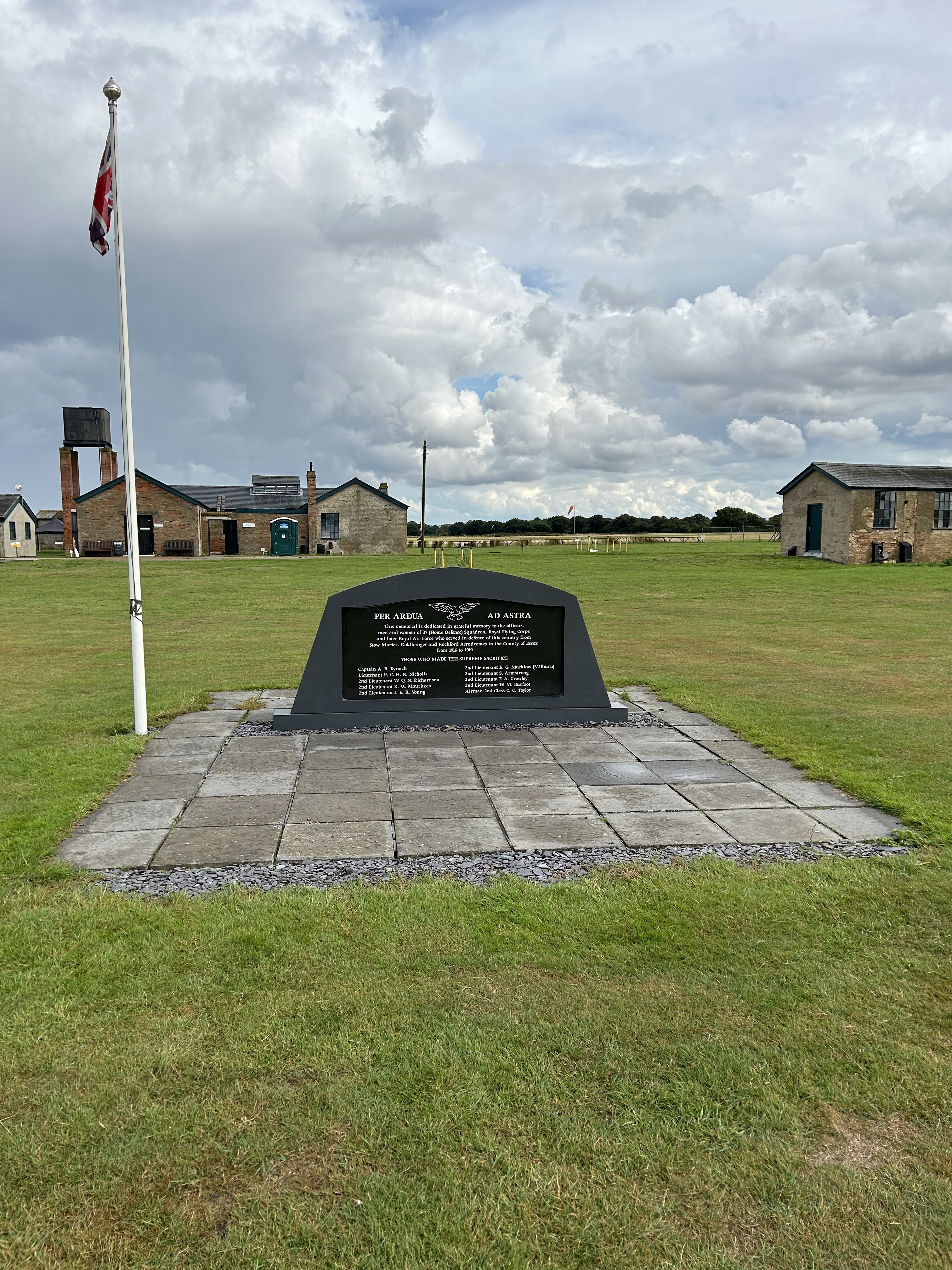
After decommissioning in 1919, the site returned to its original agricultural use when reacquired by the Turner family (the original owners of the site at the time that the aerodrome was established. Some of the buildings e.g. the motor transport shed was adapted for large agricultural machinery, but many of the other original aerodrome buildings were left untouched and fell into a state of disrepair over the years. Eventually, through local public funding the site was acquired in December 2013 and placed in the hands of a Charitable Trust, Stow Maries Great War Aerodrome Limited (SMGWA). Prior that, earlier subscription funding in 2010 resulted in the raising of a memorial to the men of 37 (HD) Squadron who lost their lives in the conflict. In 2012, the twenty two surviving buildings were assured further protection by having Grade II listed status conferred upon and in the same year the site was added to English Heritage's 'Buildings At Risk' register.

Stow Maries' distinctive water tower
 

The Airman's Mess

Interior of the Airman's Mess, restored to its 1917 appearance.

The Airman's Mess still serves as a place of refreshment and entertainment housing a cafe and library.

Interior of the Pilots' Ready Room

Here pilots would be briefed and await the 'Ready to Patrol' command that would send them running to their machines in order to intercept raiding aircraft.

One particularly unassuming, yet highly poignant, building is the mortuary which doubled up as an ambulance station. 

Mortuary/Ambulance Station


Above is the ammunition store, built mostly underground and covered by a thin corrugated iron roof, the idea being that in the event of an explosion, the force of the blast would be in upward direction, through the roof, thereby causing less damage to surrounding buildings and personnel.

The site has a couple of hangers (there are future plans to rebuild the hangers as they were during the war) where there can be found some forensically accurate replicas of the models of aircraft that operated out of Stow Maries.

The Royal Aircraft Factory's BE2e


The Memorial


It is all too easy when visiting a site such as Stow Maries to sample the tea and ice cream and get lost in the information panels of the exhibitions, but I took a moment away from all that and removed from others to reflect for a moment on what actually happened here. Standing in a field surrounded by these old functional buildings I looked across the flat Essex landscape then looked up at the grey clouds scudding overhead in the direction of London and thought about the young men who spent two or three years in this same field over a hundred years ago. They were so young, significantly younger now than my son, and whilst they were every bit in the mold of fighter pilots as we view them today, high spirited, eager for adventure and perhaps rather gung ho, they also died here and are remembered solemnly for their bravery and sacrifice.

If you find yourself in the Chelmesford/Malden area with a couple of hours to spare you could do a lot worse than pay the site a visit.

https://www.stowmaries.org.uk/


Tuesday, 21 February 2023

Remembering Private 29387 Fred Brisco 1st Battalion Lancashire Fusiliers


Extract from the 'Leigh Journal' reporting the death of local volunteer Private Fred Brisco.

It was a different sort of pilgrimage that took us to the town of Leigh on a Saturday morning last December. Leigh forms part of the Metropolitan Borough of Wigan and was the birthplace of the musician who went by the name of Pete Shelley. His band, Buzzcocks, were a major player in the UK punk scene of the late 1970s. Following Pete's premature passing four years ago, family and friends funded a mural of him on the gable end of a property close to the Town Hall. We came, we saw, we took pictures. Since the bus journey to Leigh from central Manchester is quite a trek we decided also to take the time to also view the small museum located within the Town Hall. 

Now if you find yourself in Leigh, to say 'Hi' to Pete or whatever, I would recommend you to spend 20 minutes within the museum. It has such a warm sense of civic pride and it was a pleasure to view the panels and exhibits that describe the proud industrial past upon which Wigan and Leigh grew.

Not far from an area dedicated to Pete and his band I spied a cross.... that's always going to turn my head. It was clear that this corner of the museum was intended, by way of one individual, to commemorate the huge sacrifices that the men and boys of the many Lancashire Regiments made during The Great War. 

The exhibit consisted of a reproduction of the piece that appeared in the local newspaper that reported the fact that Private 29387 Fred Brisco had been killed in action on 1st July 1916, a date seared into the minds of the British for more than a century... truly the 'blackest day in British military history'. It was the opening day of what became known as The Battle of the Somme, a British offensive that together with the efforts of the French fighting to the south would finally break the German lines and bring the war to a swift conclusion, or so it was believed. Only it wasn't decisive at all and the fighting ground on until November with very little achieved. But of 1st July 1916, it was a day that goes down in infamy as British losses were close to 60,000, killed, wounded or missing. Amongst the casualties were thousands of young men that formed Kitchener's Army, volunteers that in most cases had not been in France for more than a few weeks. Fred arrived in France just a month before the battle. The second exhibit was the makeshift cross made to mark his grave. When a permanent headstone to his memory was erected in Auchonvillers Military Cemetery, at the families request, the wooden cross was sent back to Leigh.


The cross is simply carved, bearing the words:

'In Memory Of
Pte 29387 Fred Brisco
Killed In Action
1st July 1916'

On that fateful day thousands of individual tragedies were played out across the battle's 25 mile front. Fred as a soldier of the 1st Battalion Lancashire Fusiliers was to be engaged in one of the better known engagements that took place on 1st July. The fighting that took place in the area in front of the village of Beaumont Hamel carries all of the hallmarks what 'The Somme' has come to mean in the intervening years. A lack of understanding of the enemy positions and their ability to endure the most ferocious and prolonged artillery bombardment, the effectiveness of the shelling in fragmenting the thickets of barbed wire that protected the front line and of course the resultant slaughter of thousands of men. 

1st Battalion Lancashire Fusiliers formed part of 86th Brigade of the 29th Division. The objective of the 1st Battalion on the morning of 1st July was the fortified village of Beaumont Hamel a small cluster of buildings around a church. Whilst the settlement was/is nothing to write home about, it occupies higher ground on one side of the Beaumont Hamel valley. For this reason the village was heavily fortified.


On the map above the section of the front line occupied by the 1st Lancashire Fusiliers ('1/LF') can be seen in red at the top. The 16th Battalion Middlesex Regiment and the 2nd Battalion Royal Fusiliers were located on the Lancashire Fusiliers right flank, facing the Hawthorne Redoubt. On the map, the British front line is marked in red with the German front line in green, forward of the village. No Man's Land separated the two lines. On the Lancashire front, between the opposing lines there can be seen a geographical feature that was to play a significant part in the day's fighting. Circled in blue on the map, this was known as the 'Sunken Road' (or 'Sunken Lane' in some accounts) and was a medieval banked track. This otherwise unremarkable track is also the location of some of the most famous images from the Western Front, but I will come back to that shortly. 

On the eve of 'Big Pushes' those at the top of the military hierarchy would visit the troops destined to go over the top to deliver speeches intended to remind the men of their duties to King and Country and to uphold the fighting traditions of their respective regiments.

One such speech was delivered to the men of 1st Battalion Lancashire Fusiliers by G.O.C. of the 29th Division, General Sir Henry de Beauvoir De Lisle.

General Sir Henry de Beauvoir De Lisle addressing the soldiers of the 1st Battalion Lancashire Fusiliers ahead of the assault on Beaumont Hamel.

'I cannot allow the battalion of which I am so proud to enter this great battle without coming to wish you good luck, and to give you the general situation.

We are now taking part in the greatest battle in which British troops have ever fought. At this great time all the previous engagements during this and former wars sink into insignificance. The forces that are engaged in this Fourth Army are five times as large as the whole of the original Expeditionary Force. We came out in August, 1914, with 4 Divisions, and here we have 21 Divisions.

All that military thought and science can do to make this a great success, has been done. For the first time, we have got into place as many guns as we can, and with unlimited ammunition. In this Corps alone we have just short of 600 guns. I say ammunition is unlimited. Dumped by the side of each gun is 1,000 rounds, and what they expend during the day is made up at night. We are firing away 40,000 tons of artillery ammunition; in other words, one and a half million rounds. In this Corps alone, if all the ammunition were placed in lorries they would occupy 46 miles of road.

Now, the importance of this battle cannot be exaggerated. On the eastern theatre the Russians have had a great success. They have already captured 200,000 of the enemy as prisoners. Our Allies in the West have destroyed thousands of the enemy, and now we hear that the Italians are moving forward. Now, this is the chance for British troops to show that they too, can be successful.

As you go into this great battle I want you to remember what you are fighting for. You are not only fighting to add to the glories won by past generations of the Lancashire Fusiliers. You are not only fighting to maintain the honour of the 29th Division which won its laurels on the Gallipoli Peninsula. You are fighting for your country. More than that, you are fighting for humanity. We are fighting against oppression; fighting for truth, honour and justice. We are fighting against slavery for liberty, and we are going on fighting until we have gained our object.

I would like to tell you that if we are successful during the next week, we hope to gain that object before the winter. Much depends on success, and our higher Commanders know - and I know - that all their arrangements cannot win victory. Victory must be won by the infantry, and only by the infantry.

Officers and men: Of all the battalions I have in this Division, you give me the greatest confidence of any. To you has been set the most difficult task - that of breaking the hardest part of the enemy's shell, and I expect you to break that shell in the German first system of trenches.

Officers and men: I wish you the best of luck, and I leave you with the highest confidence, that what any man could do, you will do, for your country.'

Rather than describe the events of the day, I have reproduced the official account of the fighting as it appears in the Battalion's War Diary. Written just hours after the events that are described occurred, the contemporary description of the action I think conveys something of the confusion and horror that is lost in secondary accounts.

All I need to say is that the preparations for the assault started as 3 am when soldiers of the Battalion passed through a tunnel that ran out into No Man's Land from the British Front line trench. This tunnel lead into a communication trench that ran into 'Sunken Road'.

The war diary account that follows picked up the events from 7 am on the morning of 1st July:

'Account of action 1st July 1916
Attack of 1st Lancashire Fus on BEAUMONT HAMEL.

At 7 am Battn H.Q. moved from White City to Sunken Road and at the same time the enemy began to shell the Sunken Road with 77 cm guns and inflicted about 20 casualties. They had probably spotted the communication trench leading from the end of the tunnel into the road.

0720. The mine under HAWTHORNE REDOUBT was fired and although it was not visible from the road, all felt the ground shake. B & D Coys (Companies) were lining up in position for the assault. D Coy had to be careful not to expose themselves as the Northern end of Sunken Road is shallow, and B Coy had to carefully select their exits, as the bank is overhung & lined with trees at the Southern end. 86th Stokes gun battery opened hurricane bombardment on German first line. 

0730. The leading sections of B, D and bombing Company dashed forward in extended order, D Coy being led by 2 Lts CRAIG, GORFUNKLE & SPENCER, B Coy by 2 Lts PRESCOTT, EDWARDS & KERSHAW. At the same moment 1 platoon B Coy under Lt WHITTAM & 2 platoons bombers left our trenches S of BEAUMONT road. A Coy began to leave front line trenches in support of B & D Coys.

The leading 2 lines of B & D Coys had a few moments grace and then enemy M.G. (machine gun) opened & a storm of bullets met the attack. The third and fourth lines of B & D Coys were practically wiped out within a few yards of Sunken Road though some wounded, including Caps NUNNELLY & WELLS the two Company Commanders managed to crawl back.

‘A’ Coy had also suffered in their advance to Sunken Road, the three subalterns all being hit & many men. Capt MATHEY reached the road and dashed on with the men who entered the Northern End.

C Coy caught the M.G. fire as soon as they left the trenches. Capt DAWSON and C.S.M. NELSON being hit on the parapet, when giving orders to Coy to advance. 2 Lt CASEBY and about 60 OR (other Ranks) reached the Sunken Road, but one platoon under Lt Jones got blocked in the Communication trench by wounded.

The bank into the Sunken Road is a steep drop of about 15 feet & men encumbered with coils of wire , mauls etc rolled down this to the bottom.

There now ensued some delay whilst C Coy & remainder of A Coy who had entered down steep bank were collected & sorted from the 100 wounded who had by now collected in Sunken Road, preparatory to further advance.

Sgt CAULFIELD a Lewis gunner had located a M.G. behind some debris in the village, and he pointed this out to CO. Two Lewis guns were established towards it. Planned to put it out of action, but the German artillery and observation was very quick and they were immediately shelled by 77 cm guns & 1 gun was hit, still the M.G. ceased firing from that position.

It took nearly half an hour organizing the further advance & at 0815 the CO ordered the Stokes guns to open a rapid burst under cover of which 2 Lt Caseby led forward about 75 OR who had been collected.

This reinforcement was launched from the N end of the road to try & gain a footing towards Northern end of the village, where the ground is higher.

All ranks dashed forward bravely, but on topping the crest, just 10 yards from the Sunken Road, they were met by the same heavy M.G. fire & only Lt Caseby and about 10 OR reached the German wire.

It was now 0830, and no reports had come from the front, & it was not possible to see from the Sunken Road what was happening on the flanks, so CO returned to our trenches to get news there.

Major UTTERSON reported that besides the 10% reinforcements, who were holding front line system there were about 30 men, who had not gone over the top owing to being blocked by wounded. These were collected.

Very little movement could be seen in the German lines & the village was certainly not occupied by our troops & fire had died down. Around HAWTHORNE REDOUBT about 25 Germans under an officer could be seen working round the crater. One of our M.G.s opened on them, but had to cease almost at once as enemy artillery blew in the parapet by them in under 3 minutes.

Returning to the Sunken Road there was nothing to be done, as we had no reinforcements. At about 0945 there was a sudden retirement on our right or Southern flank, presumably Royal Fus & Middlesexs. Everyone thought for the moment the Germans were counterattacking, (illegible) seemed to more possible from our point of view. We had over 100 wounded in the Sunken Road & they tried to make a rush for the tunnel. This was soon quelled & about 50 fit men were made to line the bank at either end. 25 under Sgt Green began digging at the Southern end & making a barricade & about 35 did the same at the Northern end. 

11.45. Time passed & at 1145 GS43 from GOC 86th Battn was received. GM17/1 sent in reply*. There was no time to receive an answer to GM17/1 & orders were given to Major UTTERSON that at 1230 he was to advance with his 25 men with all that was available in our front trenches, exclusive of the 10% who were not under our orders.

The remaining men in Sunken Road were got ready to advance, if Major Utterson’s reinforcements reached the road.

Although there was no chance of achieving anything on our own front, there were about 700 men in our trenches opposite the Hawthorne Redoubt, & to help them it seemed necessary to attract as much M.G. fire as possible on ourselves.

Unfortunately only Major Utterson and 4 OR reached the road, and the troops on our right never moved, so our sacrifice was in vain. Still it showed us that the enemy still held the village and that his M.G.s were intact. 

There was now nothing to be done except to hold on to the Sunken Road.

Further steps were taken to improve entrenchments already begun, & the wounded who could move by themselves were allowed to crawl back to White City via the tunnel.

1 pm. Received BM & reply CM15/1.
1.50 pm. CM16/1 despatched.
2.10pm Capt FULTON (attached to Brigade Staff) arrived and talked over situation & informed me that Sunken Road must be held at all costs.

Nothing else changed the situation for the remainder of the day, except the German shells which dropped into Sunken Road caused a few more casualties, & the Germans sniped and killed a load more of our wounded whenever they moved or tried to put on their field dressings.

At 6 pm remainder of men except 1 officer and 25 withdrew from Sunken Road , that night all available stretcher bearers and men searched the field for wounded.

The day had cost the battalion many valuable lives. Casualties were 7 officers killed, 14 wounded & 500 ORs. The battalion fought well, but the enemy was ready for us & had plenty of M.G.s & against them no troops with a strength of only 1 ½ men per yard can hope for success.'

* Messages stating that the Sunken Road must be held at all costs.

So there you have the story of the 1st Battalion Lancashire Fusiliers in front of Beaumont Hamel, one of the British units more or less annihilated on that 'blackest day in British military history'. Post battle, more accurate casualty figures were established, the widely accepted numbers being 165 killed, 312 wounded and 11 missing presumed dead.

Private 29387 Fred Brisco aged 21 years was one of the 165 fatalities. His headstone in Auchonvillers Military Cemetery bears the inscription 'HE NOBLY ANSWERED DUTY'S CALL HE GAVE HIS LIFE FOR US AND ALL'.

Presenting this information, so intimately connected with the death of Private Fred Brisco in the form of contemporary records prepared only a day or so either side of the 1st July 1916, does I feel strip away much of the tragic romanticism that has become part and parcel of the Somme story over the intervening decades. These are the facts, unencumbered by the analysis of the battle and its extraordinary aftermath. I think that the account is all the more shocking for that.

I mentioned that the battle would be the location of some of the most well known images of the war. 

Geoffrey Malins of the Gaumont British Picture Corporation and John McDowell of British & Colonial Films were sent by the British Topical Committee for War Films to record a documentary of the activities of British troops on the Western Front. Some of the footage was shot between the 26th June and 7th – 9th July and as such captured some of the preparation for and the opening of the Somme offensive. Malins captured the men of the 1st Battalion Lancashire Fusiliers in the Sunken Road just prior to the start of the attack.

Still image from Geoffrey Malin's footage showing the men of 1st Battalion Lancashire Fusiliers at around 0700 on 1st July 1916 ahead of 'going over the top'.

In contrast here's a photograph of the lane that I took about 20 years ago.


Malin's also witnessed the detonation of the mine under the Hawthorne Reboubt, a fortified German stronghold, mentioned in the account of the battle.


And this is a view into the creator in the early 2000's.


Malin's footage was used in the newsreel presentation 'The Battle of The Somme' which when shown in the UK in August 1916 attracted an audience of 20 million. This film marked the beginning of a new chapter in war reporting.

This photograph depicts a view towards the German lines from the British position in the Sunken Road (itself in the middle of No Man's Land). The wooded area centre left is Beaucourt Ridge where another German stronghold, The Berkwerk, was located. Machine guns from this area took many casualties. The spire of Beaumont Hamel Church can be seen on the right of the picture. Piognantly, in the centre of the photograph about half way between the Sunken Road and the Beaucourt Ridge the portland stone topped brick entrance pillars of Beaumont Hamel British Cemetery are just visible. A number of Lancashire Fusiliers and Middlesexes are buried here. This is as far as they got.


Sunday, 15 May 2022

Remembering Lance-Corporal Norman Higginbottom Royal Marine Light Infantry


A couple of weeks ago, a friend mentioned that he had picked up a book that I might be interested to take a look at. Knowing of my long-standing interest in military history he passed onto me a book that he had just picked up in a local charity shop for a couple of quid. Now, being a borderline horder it never ceases to amaze me the things that people are happy to chuck out. So what about this book…

Entitled ‘The Roll of Honour of Old Morleians and The Muster Roll of Those Who Served in the Great War of 1914 – 1918’, it is a volume partially bound in leather that commemorates a school’s alumni who participated in the First World War. This takes the form off the Roll of Honour to those who made the supreme sacrifice on the battlefield and a Muster Roll of those who served and survived. For each ex-pupil a brief biography is provided. Later in the book, a number of brief accounts of an alumni’s experiences (recounted here) of training, transfer to France and life in the trenches, are given. It seems that these dispatches were given to the school by the family of the late Lance-Corporel Higginbottom for inclusion in the book. These were experiences of the common soldier that would be representative of most of the pupils honoured within its pages.

What strikes me as being especially interesting about this book is its simplicity. It is a humble and poignant document of remembrance to the lost generation of 1914-1918. For all that, an immense sense of pride radiates from these foxed pages that is palpable to the reader even after the passage of one hundred years (the book was published in 1922).

Morley Secondary School came into being in 1907and was the town’s first publicly funded schools. Latterly it became Morley Grammar School and it still exists today in the form of Morley Academy. The photograph below is contemporary with the book. A piece of field artillery from the war can be seen in front of the school building.


Morley Secondary School 1921

The exterior is pretty much unchanged today.

At the outbreak of the War the ex-pupils of Morley Secondary School enlisted to fill the ranks of the British Services, mostly in response to then Secretary of State for War, Lord Kitchener’s direct call to the yound men of Britain, ‘Your Country Needs You’. As a town on the outskirts of Leeds, many of the Morleian recruits were formed in to what became known as the 15th Battalion (1st Leeds), also known as the ‘Leeds Pals’. This pals battalion, like so many others of Kitcheners New Army that were formed along the same principles , suffered such appalling casualties on 1st July 1916, the opening day of the Somme offensive. It is a date that appears several times in the Roll of Honour.


This piece focuses on just one of those ex-pupils that were killed in action. But before reproducing his experiences as recorded in this book of remembrance, I will hand you over to the Headmaster for a few words.

The compilation of this book was undertaken two years ago in the belief that its details of war service and the descriptive matter contained in it would prove of lasting interest to many Old Morleians now living, and the hope that in the years to come it might be looked upon by the children and grandchildren of those who played their part in the World War of 1914-1918 as something to be treasured.

The compiler's thanks are due to all who have supplied the information contained in it, and in particular to CAPTAIN HERMON MARSDEN, M.C., and Mr. E. NORMAN LEE, past and present Presidents of the Old Morleians Association, for their valuable help and advice in its production.


H. B. BROWNE,
Headmaster


MORLEY SECONDARY SCHOOL,
May 1922.


Norman Edwin Vaughan Higginbottom, the only son of Mr. and Mrs. James Higginbottom, of the School House, Churwell, was born at Belper, and attended first in Morley the Queen Street Wesleyan School, of which his father was then Headmaster. Later he was transferred to Bridge Street Council School, whence, in 1909, he won a County Minor Scholarship to the Secondary School. From this year onwards he became prominent in the Churwell Troop of Boy Scouts. In 1914 he passed the Northern Universities’ Matriculation, and entered Leeds University as a King’s Scholar.

Early in 1915 he joined the Officers’ Training Corps at the University, but shortly afterwards transferred as a private to the Royal Marines, in expectation of service at sea. After training in Hampshire, he took part in putting down the Dublin rebellion of Easter 1916, and was appointed Lance-Corporal in June. Having volunteered for service in the Machine Gun Company, he was sent out in the British Mediterranean Expeditionary Force, and landed in France on the 5th of September. On 13th November the same years he was killed in the German first line during the capture of Beaumont Hamel, and is buried in the “Y” Ravine Military Cemetery.

Manoeuvres: A Contrast
(The Actual Experiences of the Writer)

1. – DAY MANOEUVRES

The platoon left Barracks three hours ago, and now lies strongly intrenched on the top of a hill which commands the landward head of Portsmouth Harbour. Their trenches are but a ready-made ditch which they have improved so as to afford some shelter, but what of that? The attackers, when they arrive, will have no cover for the whole length of a long field, up which they must charge.

The officer has not forgotten to put out his sentry-groups, and one man has climbed into the branches of an elm tree, the better to survey the scene. And what a scene it is! The hill is girded by woods just bursting into leaf, and interspersed with patches of golden -brown bracken and dense green thickets of holly and furze, whose red berries and golden bloom make a rich blot of colour in the general scheme. To his right the rolling downs of Hampshire stretch away, one behind another, like green billows suddenly frozen. Before him the Isle of Wight floats, a fairy vision, on the deep blue Channel, the effect being all the more wonderful for the slight haze in the lower air. This makes the island appear as if it were being gradually melted into the ocean. Above him the sun rides in a cloudless Italian sky, full of the song of the larks. The whole scene is one of peace and springtime - for spring comes early in Hampshire.

But, turning his head, the sentry looks down into Portsmouth Harbour. The impression of peace is now rudely broken, for six miles away can be seen the town, with the smoke of its dockyards ascending. Moving about in the harbour are many great warships, which at that distance look like toys. What a contrast-busy life and slumbering nature, grim destruction and rural peace!

What is that? Something on his cheek makes the sentry turn his head to see what has touched him. It is only a fluttering gnat, one of a crowd dancing their little life out in the sunshine. Idly he watches their evolutions, when-surely that was the glimmer of brass by the haystack eight hundred yards in front?

Yes, there it is again, and again! The sun, shining on the enemies' cap -badges, has traitorously heliographed their position to him. He descends the tree and gives his information to the officer, then climbs up once more.

He can just discern two long lines of creeping figures among the bracken and gorse. Oh, that is better! Now they are crossing the edge of a patch of emerald -green meadow, and show up much more distinctly. Two platoons are creeping up to our right, and two are ranging themselves in extended order along our front. One section of men, with the Maxim, is on the left. Altogether a dangerous formation for us, and down he goes again with his news. As a result of the information given, half the platoon is sent out to the left, keeping well down, and works into rear of the enemy.

Meanwhile the enemy has cautiously crept up to the edge of the bracken without, as he imagines, having been seen, and suddenly he opens fire with "blank." As if by magic, a crowd of protesting birds appears in the air. Suddenly the Maxim gets under weigh, and under cover of its fire the enemy rushes forward fifty yards and then drops flat. Three times they repeat this manoeuvre. Once again, then they will charge the last fifty yards and , in spite of our " blank," will drive us out at the point of the bayonet. When will our flank men get to work? Only they now can save us. At last! There is a sudden yell from the left. The machine gun has been taken, and now it is turned on its late owners. Caught between two fires, the enemy hesitates, and then charges back to its lines, defeated. We hasten them by a heavy fire of blank, and with mighty cheers. Then we await the bugle which calls us together to march home. At last it goes, and full of mirth and songs we wend our way home. Who could do aught but be merry when Nature is awakening to another spring?

II. – NIGHT MANOEUVRES

“To -night's the night!” Smarting with the sense of yesterday's defeat, the other platoons of the Field –training Company are trying to capture our position. We occupy a line along the road to Southampton, while the others will advance from the Solent shore.

Two hundred yards in front of the line lies a piquet, with its sentries put out in position. Only one sentry may reconnoiter at once, in case of surprise. Let us follow this one in his wanderings.

It is a calm, still night. The sky is cloudless and the moon reigns over her court of stars. The sentry comes to a dense furze-thicket, with narrow glades full of dead, dry bracken, and there lies down. Not a sound breaks the stillness of the evening, not even a murmur from the trees. It is precious cold, thinks the sentry. Why ever didn't he bring his gloves? What a shame they weren't allowed to wear greatcoats! If the Adjutant had only once been a Private! - Good heavens, what was that? Fearfully he peers forward into the darkness whence came that shriek , expecting to see some phantom or other. Nothing happening, he stands up and moves on.

Here is something uncanny, and no mistake! Before him in the shade of a clump of sombre willows , lies a large still pool reed -fringed. On the surface of the water, half in the moonlight, half in the shadow, a pale, bluish flame,

“. ... flickering in a grimly light ,
Dances on the mere . . .”

Forgetting all about methane and its association with the the “Chemy. Lab.” and with marshes, he stands rooted to the spot. Every lurid ghost story in Pearson's that he ever read comes back with unpleasant vividness to him. A clammy dew covers his forehead as a light puff of wind, ruffling the moaning sedges, blows the flame towards him. Then once more bursts out that awful cry, only nearer. Galvanised, the sentry leaves for his piquet, while the author of the cries swoops forth into the moonlight and away over towards Rowner Church.

Five minutes' rest among the bracken, backed up by much internal reasoning, gives the sentry courage to creep out once more from his nest. A light cloud now veils the sky, and the moon is but dimly seen. Overhead a bat flutters by. Yes, this is “the very witching time of night.”

Going a little way to his left, he lies down again, and listens hard, as he cannot see. For two hours he lies there, watching the hands of his luminous watch creep round, when suddenly the narrow passage among the bracken is obstructed by a creeping figure. “Hands up!” - and the sentry triumphantly returns to his base, his fuming prisoner in tow.

It is now our hero's turn for a spell off, so, while his prey is being questioned, he makes himself comfortable on a bed of bracken which occupies the centre of a clump of gorse bushes. Two of his comrades are there, and they are presently joined by another two. One essays a riddle: “Why is a murder like a chicken going across a road?" No answer. The inquisitor replies in triumph, “Because it's a fowl proceedin'.” Shrieks of silence, amid which the funny man subsides, cursing human density.

Time drags slowly. It is two hours later that a couple of long blasts call us to the rendezvous, a sign -post some few yards up the road. Here stand ready the whole of the platoon, with the defeated enemy, who were caught neatly owing to their scout having been taken by our hero. Precise details are lacking, but what matters that? Pipes and cigarettes alight, the platoons set off through the darkness in silence. The night has cast its spell over all, and somehow it is impossible to be rowdy, as is the usual custom when returning from manoeuvres.

ROYAL MARINE (O.M.)


Active Service

I. – DEPARTURE

Thursday, April 28th-the Barracks lies bathed in the level rays of the setting sun. All along the edge of

great colonnade facing the Parade groups of Marines stand gossiping. The main topic is – “What has happenedthose men who left Barracks so hurriedly last Tuesday midnight? Have they gone to Ireland, perchance?“ Gossip and the mutual recriminations inseparable from the Marines' usual conversation

are interrupted by a fierce blast on a bugle - it is the “Alarm.” As by magic the buildings empty on to the Parade, and cottages near by the Barracks the married men come pouring in. Without fuss the ranks form up, in their platoons or in their Companies and march down to the drill-shed. Here much picking and sorting-out goes on, and at 8 p.m. a whistle sounds reducing chaos to silence. “The men on the left flank will fall in at 9 p.m. in marching -order,” shouts the Adjutant. “Dismiss!”


At 9 p.m. a joyful crowd assembles, with every haversack crammed with extra necessaries and the big valise (carried on the back) packed tightly with its regulation contents and other items. And then ensues a fearful two hours. For pouches are filled with two hundred cartridges, water-bottles filled, blankets strapped on the pack, emergency field -dressing taken on board, and life-belts, like motor-tyres, put on under tunics. At 12.30 a.m., after a brief rest, the Company marches out of Barracks. Not a man but is silently anathematising his equipment long before he reaches the station; for it weighs a hundred- weight and a little over. In silence the Company entrains, and loses all further interest in things till in ten hours it is disembarked at Pembroke Docks. So we are going to Ireland after all!

A whole afternoon is spent in loading up the troopship Archangel. There are no fewer than two thousand Marines from Chatham, Portsmouth and Plymouth, with the Marine Artillery and several Companies of some Army units. There are several field -guns, fifteen Maxims, ammunition, hand grenades, extra rifles and stores in huge quantity. This will “some” haul for a submarine, think we. But all gloomy forebodings vanish at sight of our escort of destroyers.

Luckily it is very calm, so a good passage is made, and early next morning we land at Queenstown, where the Marines go on board H.M.S. Albion, leaving the Army to its own devices.

It must here be mentioned that the Marines were only on the Albion for a few days, after which they went on shore. But as no details of what they did can be given, a description of life on the Albion must suffice.


II.- ON A BATTLESHIP

Steel, solid steel, everywhere. Decks, masts, funnels, cowls - everything of steel. Stripped of any paint that once may have covered her below decks, the utter brute strength of the monster is thrust on one. Stand for a few minutes in one of the casemates on the main deck The first thing one sees is the six -inch gun, whose long barrel projects through the port. Her breechend takes up the whole port side of the small space, a mass of shining steel and burnished brass, of levers and wheels. Around the casemate hang, each in its own canvas bucket, the shells that are the gun's food-not big to look at, though each weighs one hundredweight, and the gun can throw it five miles with precision. Below one's feet is a steel deck, with trap-doors through which the ammunition comes up in a hoist when the ship is in action. And the entrance to this grim chamber, devoted to the dissemination of death and destruction, is through a narrow doorway in a six -inch bulkhead of steel, the door itself resembling that of a safe. The place is depressing - it weighs one down by its gloominess. Let us go out.


H.M.S. Albion

The door gives on to a steel-decked passage. This leads past open spaces where hammocks are slung, past ladders leading from the upper -deck, past tanks and pipes and strange pieces of machinery, past the galley, where a gigantic stove hisses and glows, preparing the crew's dinner. Here are openings leading to the magazines and torpedo -chambers, and here again is the hatchway, black as a pit shaft, which leads down into the lurid chasm where the stokers work at the furnaces-a chasm which is a chaos of sounds from machinery and boilers, a nightmare of strong red lights and intense black shadows.

Come up on decks. Here the first things noticed are the great turrets, of twelve -inch steel, from which project the huge twelve-inch guns. Guns everywhere, of all sizes, from a Maxim upwards. This particular ship is very old, being a pre –Dreadnought of 1898 ; hence she carries only four twelve -inch guns and twelve six -inch guns, with four little twelve -pounders and two Maxims. But she is still a great craft. Amidships rise two large funnels. Fore and aft are two bridges, each with shelterdeck below, and mast with control-tops above. The masts are of steel, and secured by mighty wire hawsers. Of boats she carries a variety, including several sailing -vessels and one steam picket- boat. But if one wishes to gain the most lasting impression of the vessel's might, let him go forward into the bows, and lying on his face look down at the ram, a mighty mass of steel lying below the water -line, which is thirty -seven feet below. What damage that great spur could do if driven into an enemy's side with all the weight of the ship sending it on!

The sun is sinking behind the hills of Old Ireland. A peculiar golden haze flecked with great crimson clouds, fills the upper air. The shadow of the ship lies black upon the shining , placid sea, to whose margin the hills sweep down, clothed in vivid green. Only one thing mars the scene-a large house, fired by the rebels still sends up a thick column of smoke, as if in protest against its treatment. The fo'c'sle of the ship is filled with Marines and bluejackets, for they have knocked -off work for the day. Suddenly a bell rings slowly five times - it is five bells in the second dog -watch, or half-past six. A bugle rings out. Immediately everyone is standing to attention, while the White Ensign emblem of British Naval Power, slowly climbs down from its staff on the after -bridge, over the quarter -deck. At last it is down, and the company sits on the deck to resume its interrupted occupations.

Yet another call! This time it is answered by the whole ship's company with a rapid “double” aft; for the grog -tub is out in the main gangway and everyone goes for his tot. "Grog" is a nauseous mixture of rum and water, mostly water. It is very uninviting both to see and to taste, but the ship's company appear to be of a different mind. The extent to which they will soak up this enticing fluid - if they get the chance - and the extreme rapidity with which they personally surround their portions, cannot be well expressed on paper.

III. – HOME AGAIN

The troopship Connaught lies peacefully at anchor in Queenstown Harbour. Her escort lies alongside her, in the shape of a torpedo -boat. There is every prospect of a rough passage. As this information is passed round there are those who shiver; there are also those who are filled with unholy glee. Good sailors these, who will gloat over the sufferings of others. A somewhat gloomy Company retires to its bunks at two bells in the first watch-9 p.m.

The writer wakes, with impressions that he is somehow in a steam-swing that has gone wrong at Holbeck Feast. He hears a groan-then he remembers, and sits up. How stuffy it is! Suppose we go aloft. A good seaman, he manages to get up on deck very well. There are here a few other Marines looking anxiously into a thick, white fog that surrounds the vessel. Out of this fog mighty billows sweep in unending procession and try to wash over the vessel; but she is a good sea craft, and manages to keep her decks fairly clear of sea-water. Ah, what was that? Surely a bell rang? Yes, there again, and again, very irregularly. Again comes the sound, from almost under our bows. There is a sudden yell. Someone shouts quick orders; the vessel's engines stop and then go full-speed astern. One of the ship's crew, very white-faced, comes astern. "What's up?" “Oh, only lost our way in the fog, lost our escort through the same cause, and now only just stopped ourselves from running on a great rock.” He further volunteers the information that the captain doesn't know where we are; but thinks we are some - where about a hundred miles out of our course. Cheerful, this!

And then there emerges from the vestibule under the poopdeck, a wan, stricken, pale-faced crowd. Marines and sea-sick! They trickle slowly down to the rail, and there cling in their misery. Now is the opportunity of the charitabl! With ghoulish merriment they crawl along the rail, offering pieces of bully -beef to the stricken, whose anguish is thereby increased. For a sea -sick man cannot stand the sight of anything greasy.

A few bold spirits, to show themselves worthy of the title of Royal Marine, promenade up and down the slippery, plunging decks. Anon comes an extra big lurch, whereat the promenaders, wildly clutching at emptiness, all fall down upon the wretches at the side, who can only give a sort of crescendo to their groans. They are too far gone for anything else.

Breakfast, of tea and the eternal biscuits and beef, is presently served. But less than half the Company can even look at it. So a few improve the shining hour and fill up every pocket, because we have a very long train-ride before us when we land.

Suddenly the fog lifts. Immediately there flashes upon the vessel a ray of light! An old sailor who is part of the ship's crew observes the same. It is the Smalls lighthouse, he says, after counting the flashes. And the course is changed accordingly.

On right and left rise mighty portals of granite cliff, black and forbidding. We are steaming into Pembroke Harbour. Faces that were green become more natural-looking. Chatter displaces groans. And when the anchor is firmly gripping bottom and we are at rest in harbour, there rises up that familiar ditty

“Here we are again!”

But when at last we disembark at the quay, a sort of gloom falls on the crowd. One of us is left behind in Ireland, and will never return. Honour to his memory!


ROYAL MARINE (O.M.)


At the Front

Extracts from letters written home by the author between the date of his arrival in France, and that of his death in the British attack at Beaumont Hamel on the 13th November 1916.

Tuesday, September 5th.

We blew in this morning after a rough passage, full of hope - and biscuits. Of these latter we have already had more than a feast. It was rather thrilling piping down last night. We were in the forward hold of a cargo boat that has been convertedinto a troopship, and though there were stools and tabIes and shelves there were no bunks. Therefore I piped down on a fixed bench, the tables above being also full of slumberers . Precariously balanced on the 9-in. plank, I fell asleep being rudely awakened by our sick -bay steward’s jamming a yery well-armoured boot toe into my right eye. Removing same, I roused him a little and complained. But he, being “sunk in swinish sleep,” only grinned in a beastly manner and turned over. I descended to the deck, and found myself, to stretch a metaphor, out of the pan and into the fire; because a driver just behind me was alternately trying to puncture my head and my air-pillow . I gave it up at last and went on deck. Here it was raining hard, so I descended again and had a wash. I woke at 4.45 a.m. to hear the sergeants going round persuading us to rise. I rose; washed again; didn't shave; and had a hearty breakfast of biscuits, jam, cheese, bully, and tea.

Monday, September 11th.

France as seen from a train is very much of a muchness, as the March Hare said. Nothing but miles of long roads, with peculiar trees placed severely two deep along them. There were plenty of orchards, too, which looked very tempting, but whose produce wasn't. Some French kids threw a few to us. I have chewed pens in exams., and thereby drawn inspiration; but from these apples one got nor juice nor inspiration. The villages one saw were all alike - a few houses bewilderingly tiled, an inartistic church, a few orchards, perhaps a few pigs sculling in the road.

We are in billets, just behind the line. There are any amount of guns about, and they fairly shake the house . At night it is very fine to hear them. They never bother me; last night some German shells dropped near this place. Occasionally we see an aeroplane being shelled up in the air; there is one having the experience now, just opposite the glassless window. It is one of ours, and he is making rings and curls and glides in the air; but not going far, just to make game of Fritz. We never hear much rifle firing, but plenty of machine -gun firing at night. The sound of rifles does not-carry so far as that of machine -guns.

It is peculiar what different noises the shells make. Some explosions are like the sounds heard along Bridge Street on Friday night when the people are out shaking their hearthrugs. Others are more like short snippets of the great explosion at Heckmondwike before I joined up. The shells make different noises, too, as they go along. Some are like a violin gently slurring up from one note to the next above it, through all the intermediate notes that you can't get on a piano. Others make a hissing noise. Others again start off with a hiss, which soon becomes a violent shaky row like a train going over a bridge very fast.

I have learnt that it is one thing to write French and another to speak it. Also that “Matric.” French isn't much use when you want to buy, say, a tin of dubbin or a pair of leather bootlaces. Still, I can talk to the aborigines, who still cling to their shellswept homes and keep shops for our benefit. Also “pubs,” than which I never saw anything more numerous. Every second shop is an estaminet. But I digress.

I am fed up with the money here. You get change in English and French coin. Of notes I believe I have as many as that caligraphic expert, Dr. Wilson, U.S.A., has written in his whole career. All values they are, from 2 1/2 d. upward. Fancy, 2 1/2d. notes! And every town seems to issue its own, all different in pattern. But all agree in being creased, dirty, greasy and generally unhygienic.

Sunday, September 24th.

Sunday afternoon! Normally I ought to be with a dozen little friends in a class room, endeavouring to instil into their youthful minds some precept or other; but here I am, lying amid straw and chaos, inditing this epistle. We've had the usual stew for dinner. It's much improved now both in quantity and quality. No one grumbles at the stew. Yesterday there were four kettles full of boiled rice, sweetened. The greedy swine rushed for it as if they'd never had a crumb this last twelvemonth: some got canteens full, some was spilt, the majority got rien. As I was too dignified to rush for some rice, I got left. Next time I'll be waiting at the early door. I won't rush, oh, no! But I'll be there all right.

Since we came out I don't think I have seen a country village half as prosperous as the average English one. There are houses, unruined by war, that would be uninhabited in England; and you never saw such awful roads . But then, I expect the men have gone. Moreover, you don't see a village church of the same beauty as an English one . The country that gave to the world Rheims Cathedral, the flower of Gothic architecture, seems afraid to tackle the Gothic styles nowadays. Its people are content with ugly semi -classical barns with absurd spires, buttresses (of all things!) , and absolutely nothing characteristic.

I went into one the other day and lo, the prismatic glories of Gildersome faded from my memory. Highly -coloured windows and images , three gaudy altars, ditto stations of the Cross – it was most tawdry. There was rather a nice image of St. Anton of Padua with a child, and an altogether silly one of a child in royal robes crown, and sceptre. I can't think that even ignorant people would worship that toy. There was some nice illuminated work on the altars-In principio erat Verbum, etc., from St. John’s Gospel you know. It was evidently the Gospel for the day. There was some beautiful carved wainscoting round the building a fine pulpit, pews, and a confessional, all in dark oak, which somewhat toned down the general prismatic scheme of colour. I would far rather have Woodkirk, though.


St. Mary's Church, Woodkirk (just outside Churwell)


Saturday, September 28th.

Still here in our old snug barn, awaiting orders to move. It looks as if winter is setting in in good time. Woe worth us if we have a winter campaign! The trees are rapidly shedding what few dying leaves yet remain to their credit, and most melancholy they look against the grey sky. Last night there was a most awful sunset. In the west there was a lurid blaze of crimson, yellow, and green with one thin, black cloud across it. The clouds came along in a straight edge over the colour, quite black, and with long cirrus -clouds of a coppery hue across them. It was, on the whole, very uncanny and wrathful-looking.

The country round here is extremely undulating-very much like the country beyond the Chevin at Belper. There are no hedges, and very few trees or villages to be seen. It looks rather nice-like a tumbled sea that has suddenly frozen hard . It's rotten for marching, though, as I know better than well enough.

One of our mules died the other day-due to its peculiar choice in comestibles, it's thought. The brute had eaten the condenser of a gun, which it had got at by raising the limbercover. I've seen them eating sandbags, rope, and leather reins before now. But that's nothing-I'm quite used to shaving in lukewarm tea.

Tuesday, October 10th.

This is written in the trench in a somewhat warm part of the line-which may mean anything. It is very exciting hearing the shells, and “toffee -apples,” and “rum –jars” going overhead and then exploding. Last night it was all right watching the Hun lines being shelled; but it was another thing when he began to send a few over in exchange.

The battle -field at night has a sort of weird beauty all its own. A second firmament of star-shells is created - red, green, and white. And the bursting projectiles give off a weird, red glare which is somewhat like what I should imagine a volcano would show. During the day the glare gives place to puffs of grey and white smoke, pall-like.

The trenches here are all right; but muddy withal. There has been a good deal of rain, and it is a clayey soil. The result is that progress along a trench is a sort of gliding process. In some parts you procrastinate yourself along, as it were. The dug-outs are cosy, and dry as a rule. Mine isn't, though. I should say there's someone buried near, unless it's a dead rat. There are plenty of corpses in these trenches under the floor. I saw part of one yesterday, where they were repairing the wood - work. But, of course, that's only to be expected. I didn't stay long.

Sunday, November 5th.

It's a mercy that I've come down from my spell of six days unscratched. The Hun got a large number of shells along the trench, one of which exploded two traverses in front of me. The nose -cap would infallibly have removed my nose had that promontory been a foot long; it came past my face like a huge bee in a violent hurry. Later on my “tin hat” saved me from a head wound, so you see I've lots to be thankful for.

Both sides indulged in huge artillery -strafes. It was the powers of Hell let loose by two sides one at the other. A lovely sight it is to see the shells bursting on Fritz's parapets; but most unpicturesque when his start to come over to us. He's fond of using gas shells, too. The stench is awful-like a few thousand wet matches being struck all at once. I think it is phosphine they employ in these shells.

Dante missed an inspiration in not seeing our trenches. He'd surely have put a corner full of mud for the worst in his Inferno. I've forgotten whether he does or not, but anyhow it's a good idea for the scheme. One of these trenches is thigh deep in H20 and mud - the former being on top of the mud and the communication trench is a veritable horror. You should have seen me when I came out, muddy up to the eyes, not having had a wash or shave for six days. And every morning the gun's crew was stiff with rheumatism or something like it.

Tuesday, November 7th.

On our way down from the trenches we came through a ruined village. The church was a horrible sight, and as for the houses - I only wish the Hun may find a village and a church done to in the same manner for everyone of erstwhile fair France that his war-mania has devastated. The average French village church is an unlovely erection in a nondescript style. The one referred to was no exception; but ruined, roofless, windowless, its spire tower and chancel broken, it preached an eloquent , if dumb sermon of anathema against man's cruelty and devilish ingenuity. Gott Strafe England! yell the Huns, and invoke Him. And still they level His houses and the dwellings of His servants. One is tempted to ask-Why does the Almighty not visit the blasphemous hypocrites in the midst of their wickedness? Thank goodness we're slowly but surely visiting their sins upon them. I’m glad to be a machine -gunner. I can layout more of the swine that way . Do you know, when we were strafing up in the trenches at night, I felt not the slightest compunction in letting swift death loose upon the foe. And may I live to repeat the process! Seeing things like those I have mentioned makes one angry without sinning.

Thursday, November 9th.

You ask-how do we keep dry? Well, we don't. When we're wet, as often as not we must stay thus. I've not had dry feet for over a week. I don't mind the water in your boots; but when it comes to trench -mud “siping” in I do draw the line. Trench -mud is extremely odoriferous; when stirred up it smells of unutterable corruption. In this gloomy viscosity we live, move, and have our being; and by way of refreshment we inhale the fumes of Hun shells and dodge into “funk–holes” when we hear them coming. Sometimes we're in an unlucky spot and the place comes in; but that is all as it may be. Chance it! One of our men was buried, but got out again in time.

We had Ora Pro Nobis Stew for dinner; which same entrancing dish has formed the menu for the last goodness-knows-how-many weeks. It's a quite innocuous compound of bully, tinned beans, spuds, and water (in abundance). Sometimes there's bacon in it, too, which makes it horrid - to me, at any rate. But without bacon it's not bad, although it is called by that horrible name. Cheese for breakfast, and once for tea and once for dinner this last four days-with bread or biscuits, of course . Hurray for the cheese! The Red Cross man was busy with his “number 9’s” last night, and I with my little medicine case, end compartment.

Friday, November 10th.

Mother must not build on seeing me again till the end of the war. I'm prepared to stay here for the duration thereof. Unless, of course, I'm so lucky as to get a “Blighty” or go sick. We have some men in hospital now, and this morning I went sick, as you shall learn . Ever since we were up the line amongst the mud, I have had neuralgia in my jaw, and last night, unable to stand any more, I went to the S -M. and told him I was going sick on the morrow. I did. The man of the “number 9 's” shoved a shoe -horn or scapula or something else down my oesophagus, and carefully inspected the depths revealed; prodded my gums and made me say " Ah "; kneaded my jaw; looked into my left orifice; and then wrote on paper and handed me over to the tender mercies of his myrmidons, who gave me a stiff dose of acetyl salicylate (such being the medical name of aspirin). Then he made me sit down and shoved a towel round my neck. Seeing one approach with a steaming, suddy liquid in a basin, I anticipated a shave. But no-one ministering angel produced a glass syringe of magnificent proportions and delivered a volley at close range into my left ear; repeating the process about twelve times till the “Doc.” judged I'd suffered enough. When they let me go, I found I'd to return at 5 p.m. to-night. I shall be there. The treatment has eased the awful ache round my earroot.

We had Ora Pro Nobis B for dinner to -day, i.e., it had a little bacon in as well as bully. I lunched off a franc's worth of “choc.” and ditto biscuits. I've had enough stew for once in a way, and am longing for a good lunch at home.

P.S.-- This isn't a begging letter.

The writer was killed in action three days later.

Lance-Corporal Norman Edwin Vaughan Higginbottom
190th Machine Gun Company
Royal Marine Light Infantry
(IWM)

The following report of the young soldier's death appeared in the edition of 8th December 1916 in the 'Belper News':

'Lance-Corporal Norman Higginbotton, only son of James Higginbottom, former headmaster of Belper Pottery School, was killed in action on 13th November. The parents were first acquainted with the fact by a letter from Pvte. W. Lloyd in the same machine gun section. R.M.L.I. A letter was also received from Lieut. C.W.R. Watson R.N., dated November 20th, who wrote of deceased as a well disciplined and superior fellow who always endeavoured to help his comrades, who much appreciated him. He was leading his particular crew during the attack when he fell. Lance-Corpl. Higginbottom was 20 years of age and an old pupil of Morley Secondary School, from which he passed to Leeds University, taking an Intermediate B.Sc. degree. He was Assistant Scoutmaster at Churwell, where his father is the master of the Council School. He joined the Royal Marines on 17th November, 1915, and was in Ireland during the Easter Rebellion, and left for France on September, 12th. Mr. Higginbottom senr., it will be remembered left Belper some 18 years ago. Deceased is a grandson of Mrs Norman, Chapel Street, Belper.'

Norman Higginbottom enlisted in York on 16th November 1915 aged 19. He was instructed to report to Eastney Barracks in Portsmouth where, on 24th November he was transferred to the Royal Marine Light Infantry (Portsmouth Division).

Norman’s active service commenced not on The Western Front but in Dublin. In his letters home he describes his unit's passage to Ireland and contends his family with a description of life on board H.M.S. Albion since ‘no details of what they did can be given’. The presence of the Royal Marines in Ireland between the 26th April to 14th May 1916 was for the purposes of quelling the Easter Rising, an attempt by Irish Republicans to end British rule in the country and to establish an independent Irish Republic. Here, according to his records, Norman was wounded (in a section of ‘WOUNDS AND HURTS’, ‘Nature of wound and Service on which employed’ the following is recorded ‘Comd H.2.E. Ireland’ – a compound something? Anyone know?).


He sailed to France on 3rd September 1916, landing on 5th and arriving on the Somme on or around 11th September according to his letter home. The aforementioned Somme offensive had failed to deliver the anticipated coup de grace to the German forces in France. This being the case, the British High Command intended to stage one more major offensive that would both restore some injured pride and reassure the French Command of the ongoing commitment of the British forces to defeat the enemy. The task was given to the 5th Army (formerly the Reserve Army) under General Sir Hubert Gough. This action would become known as The Battle of the Ancre that was fought 13th November to 18th November 1916. The conclusion of the action coincided with the end date of the Somme Offensive.

This new action shifted the fighting further to the north in an area centered around the valley created by the River Ancre. The planning was beset with logistical problems. Four months of constant shelling had created a barren moonscape of flooded shell holes and charred tree stumps. The front line was not so much a trench system, rather a series of interlinked craters. Such terrain caused infinite headaches to those tasked with ensuring that forward ammunition and supply dumps were stocked and ready and that the artillery gun pits were operational. Several delays to the start of the action were communicated in the hope that onset of winter would harden the ground and allow gains to be made before consolidating positions until the Spring.


Battle of the Ancre. British soldiers on the improvised bridge (a fallen tree-trunk) across the Ancre, November 1916 (IWM Q4568).


The intention was to recapture the fortified villages of Beaucourt Hamel and Beamont Hamel, both objective hamlets on 1st July 2016. Retaking these positions would provide a solid starting point for the capture of Serre later on, another location over which much British blood had been spilled on ‘the blackest day in British military history’.

Norman Higginbottom was at this time part of the Royal Marine Light Infantry (RMLI) 190th Machine Gun Company of 190th Brigade which in turn was attached to the 63rd Royal Naval Division (RND). These inland mariners were positioned across a 1,200m front that ran perpendicular to the northern bank of the River Ancre on their right flank. The Division faced Beaucourt Hamel. To the left of the 63rd RND were the 51st Highland Division facing the objective of Beaumont Hamel. The RMLI units were on the extreme left of the 63rd’s front at the Divisional boundary with the Highlanders.


Unfortunately, I do not have the war diary that details the involvement of 190 Machine Gun Company (MGC). It’s companion units of 188 MGC and 189 MGC attached to the 1st and 2nd Royal Naval Brigades were involved in the fighting from the off when the British barrage was laid down at 5.45 a.m. ahead of Zero hour at 6.00 a.m. Perhaps 190 MGC were in reserve only to be brought into the action later in the day. The fighting was hard, not helped by dense fog which on the one hand concealed the advance but on the other meant that the infantry lost the creeping barrage and the protection that it would have afforded them. The Germans fought bitterly in the defence of both Beaucourt Hamel and Beaumont Hamel, inflicting heavy losses on the attackers in doing so. Nevertheless, Beaumont Hamel (described by the war poet Edmund Blunden as ‘the terrible Beaumont Hamel, one of the German masterpieces of concealed strength’) fell to the British on 13th November with Beaucourt Hamel in the hands of the RND by the following day.

RMLI in Action on the Ancre
November 1916


Norman Higginbottom’s body was recovered from the battlefield and buried by soldiers of the 51st Highland Division. His remains now lie within the ‘Y’ Ravine Cemetery, Beaumont Hamel that lies within the Newfoundland Memorial Park.

'Y' Ravine Cemetery, Beaumont Hamel

His headstone carries the inscription ‘KNOWN TO BE BURIED IN THIS CEMETERY’. This I understand to be something of a half way house between internment in a named plot and a plot of an ‘A SOLDIER OF THE GREAT WAR’ containing the remains of an unidentified combatant. For reasons unknown, the exact burial location of Norman Higginbottom is not known other than that his remains are buried within the confines of the cemetery.

His grave also bears the additional inscription (partly obscured in the headstone photograph):

‘CROWNED WITH THE SUNSHINE OF ETERNAL YOUTH’