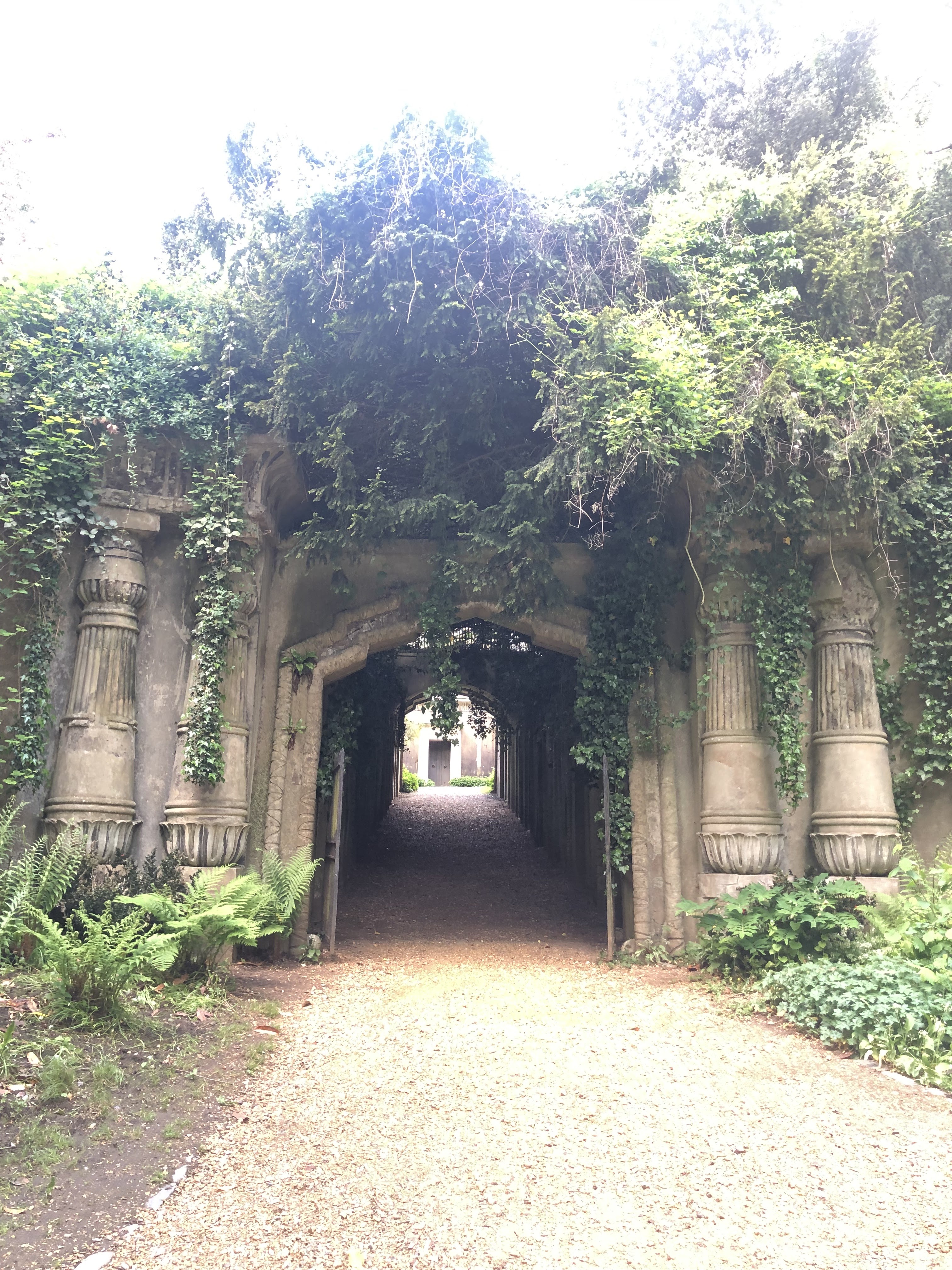
I am out of the closet (or should that be the crypt?) as a self-proclaimed taphophile. Graveyards have long held a fascination for me and many hours over my fifty plus years have been spent in cemeteries both here in the United Kingdom and across Europe.

On occasion, on my forays into these tranquil spaces, a particular grave will pique my curiosity. This may be for a variety of reasons, an association with local history, an intriguing epitaph or a family connection.... it doesn't take much. The online availability of censuses, official registries and newspaper archives have in recent years made it possible to learn something more about the lives lived by those remembered only as fading names carved in stone. These resources provide an opportunity to put 'flesh on old bones' as the turn of phrase goes, hence the title of this blog 'Beyond the Grave'.

If anyone reading these posts has anything to add please feel free to contact me at adrianandrews@myyahoo.com.

Monday, 6 June 2022

A Morning in Highgate Cemetery West - May 2022


Entrance to Highgate Cemetery West (with the Colonnade visible beyond the gate)

I’m fulfilling the start of a lockdown promise to myself here. I will over the coming months pay a visit to each of the so called ‘Magnificent Seven’ London cemeteries. These are:

  • Highgate
  • Kensal Green
  • West Norwood
  • Brompton
  • Tower Hamlets
  • Abney Park
  • Nunhead
The century leading up to the creation of the collection of cemeteries later termed the ‘Magnificent Seven’ saw a huge migration of people from the country to the UK’s urban centres as the Industrial Revolution brought with it work. This boom in city populations coupled with the Christian tradition of burial in consecrated ground in the immediate environment of Parish churches created untold problems. The City of London was greatly affected as the small graveyards of the churches in the area were hugely overcrowded. Often it was the gravedigger’s gruesome task to break up the coffins and the remains of their occupants from earlier interments to make room for new burials. Paupers graves would be dug that were upto 20 feet deep and these would remain open until such time that sufficient coffins had been placed in the plot to fill it. This could take a couple of weeks, during which time the natural processes of putrefaction were underway. The fact that demand for space hugely exceeded the space that was available meant that graves were regularly opened and reopened with the inevitable disturbance of the bodies within. Many burials were made that were just inches below the surface. This situation resulted in contamination of the ground water, a saturation of the soil with the effluvia of putrefaction and a general miasma of noxious odours in the environs of city graveyards. In turn this resulted in serious health risks to those people living ‘cheek by jowl’ to the resting places of the dead.

In 1839, English medic, George Walker published a treatise entitled ‘Gatherings from Graveyards, Particularly those of London’ in an attempt to prove the link between public health and the continued practice of interment of the dead in close proximity to the living. The work went to great lengths to describe the practices of the ancient civilisations in this respect, almost all of which forbade burials within religious buildings and in many cases even within city walls. Indeed, this was also true within the Christian faith, however, with time the laws laid down on the subject of burials were increasingly overlooked. Initially, pious men could with ecclesiastical approval be buried in the outer parts of their churches. Later this privilege was extended to those of great wealth and status that contributed to the foundation of their churches. Eventually, internal burials encroached on the interiors of churches such that celebrant’s were standing on the flagstones underneath which lay the remains of their fellow Christian congregation.

Title page of George Walker's work highlighting the dangers of interment of the dead in close proximity to the living (1839).


The crisis was recognized and wealthy entrepreneurial businessmen were quick to offer solutions to London’s dilemma.  One such set up was the London Cemetery Company established as a result of an 1836 Act of Parliament. The Company was charged with the construction of a purpose built cemetery outside of the city (it was many years before the villages selected as locations for these necropolises were subsumed by the sprawl of Greater London). The first for the London Cemetery Company was Highgate to the north of the city, soon to be followed by a second, Nunhead, to the south. Subsequent Acts of Parliament resulted in what are now regarded as the ‘Magnificent Seven’ cemeteries that ring the City of London.

Locations of the 'Magnificent Seven' garden cemeteries that surround the City of London.

In 1839, within Highgate, 15 acres of the 17 acre site were consecrated for the burial of members of the Church of England whilst 2 acres were set aside for Dissenter burials (those of Christian faith outside of the C of E).

The Important thing to remember about Victorian society is that they were obsessed with death! How one’s death was managed was a matter of utmost importance to Victorian’s both rich and poor. A plot, marker and funeral were something to be saved for throughout life. Naturally, in a society that placed a great emphasis on social standing, those that could afford to do so went big when it came to the funerary  arrangement and remembrance of loved ones. The Cemetery Companies offered many options to those planning for the afterlife. The ‘menu’ offered to the bereaved was extensive, costing grand family mausoleums to single plot graves. Death may be the great leveler but it was certainly possible to make a distinction in the manner of your family memorial.

Aside from the variety in terms of grandeur of graves and tombs to be found in a cemetery of the Victorian age there is also their obsession with the symbolism of loss that is of note. There are angels aplenty, Guardian Angels of the souls of the departed gesturing heavenward, grieving angels with eyes cast down and cherubs representing innocence and loss. Classical columns abound, broken not as a result of the passage of nearly two centuries but a representation of a life cut short, inverted torches carry meaning of a life extinguished but their flames tell of a continuation of the soul. Any self respecting Victorian cemetery will contain dozens of urns half draped with cloth to ensure that the soul within can ascend to heaven. Then, there is the Victorian preoccupation with all things Egyptian, the contemporary uncovering of the tombs and monuments of that civilization was readily reflected in the funerary sculpture of the day such that obelisks and pyramids appear in profusion!

The two paragraphs above exemplify just what I find so appealing about such places, they are so unashamedly over the top!

Having spent upwards of forty five years traipsing around graveyards it saddens me to think that in another 150 years when the leaded letters of our Victorian monuments have all dislodged and the carved inscriptions have all weathered to an illegible state, we will only be left with our modern day monuments and grave stones that in comparison are so bland and lifeless…. no pun intended. Whilst no doubt heartfelt, ‘In Memory of Joe Bloggs, beloved Husband, Father and Grandson’ cannot compete with the crowing of the achievements in life and the social standing boasts that one finds inscribed on many a Victorian headstone! And I, of course, appreciate the necessity for a scaled down approach to remembrance of the dead.

As I write this piece in June 2022 I am reminded that between November 2021 and January 2022 notices were posted on the gates of the Old Cemetery here in Bishops Stortford. These notices invited members of the public to provide comments in a consultation on proposals to re-use ‘common graves’ (those owned by the cemetery and unmarked) under the authority of a private Act of Parliament. This proposal has been necessitated, once again, by the fact that in 10 years from now both of the town’s ‘active’ cemeteries will be full. Issues of capacity in the cemeteries of our towns and cities coupled with the prevalence of cremation over burial (and I am all for the former when my time comes!) means that the spaces given over to remembrance will inevitably be lacking the flamboyance and drama of former times. I find that to be an awful prospect.

However, I digress, let us step back into the leafy tranquility of Highgate.

One of the first graves to which our attention was drawn by our guide was a recent one, that of a former member of the Russian Federal Security Service (FSB) , Alexander Litvinenko, a Russian defector and fierce critic of Vladimir Putin who, after gaining asylum in the UK, advised the British intellegence services on Russian affairs. He was taken ill in a hotel in Mayfair and died on 23rd November 2006. The cause of death was attributed to poisoning by polonium-210. A subsequent murder investigation identified two Russian suspects but extradition attempts failed. A public enquiry concluded in January 2016 that Litvinenko was murdered by the same two suspects acting on behalf of the FSB with the approval of Putin. 


Like many of his Victorian neighbours, his remains lie in lead inside the coffin, a protection from a danger lying within i.e. the radioactive agent that killed him, rather than a danger lying without that was so feared by the Victorians i.e. the 'Resurrection Men'. 

Continuing to walk up the Main Drive the visitor is confronted by perhaps the showiest contrivance of Victorian funerary construction, 'The Egyptian Avenue'. Entered through a large arch that is flanked by four lotus columns and two obelisks inspired by Cleopatra's Needle (an 1819 gift to Britain from Egypt that is sited on London's Embankment), a greeny gloom quickly envelops the visitor, who once inside the avenue is standing amid eight private vaults. These vaults are locked, the key being given over to the family so that on occasion they could visit their dead relatives (rather them than  me!). Like so much else in Highgate, even the locks on the doors to each vault are symbolically inverted. 

A depiction of the entrance to the 'Egyptian Avenue' in the Victorian era.


The entrance to the 'Egyptian Avenue' Highgate, May 2022.

A view down the 'Egyptian Avenue', May 2022.

One of the family vaults within the 'Egyptian Avenue' May 2022.

Whilst each of the vaults has the capacity to accommodate twelve coffins, none in fact are full. As a consequence of the avenue's gloomy aspect this afterdeath option fell out of favour. Even in the cemetery's own guidebook of 1865 the avenue was described as a 'cold stony death palace'.... hardly the most persuasive advertisement to those seeking the eternal resting places of their nearest and dearest! For those who could afford it a vault in the light and airy 'Circle of Lebanon' was a much preferred option.

The Circle is just beyond the Egyptian Avenue. The Inner Circle is constructed around a mound upon which grew an ancient (even in Victorian times) cedar tree, that was the centre point of the cemetery according to architect Stephen Geary's plans. The 400 year old tree, having died, was removed in 2019 and has since been replaced.

Such was the desirability of the Circle as the final resting place of the family that to the twenty vaults of the Inner Circle, an Outer Circle was constructed. 

The Circle of Lebanon showing the inner and outer circle of vaults.

The Circle of Lebanon is a Grade 1 listed architectural feature.

Our tour moved on to the Terrace Catacombs located above the Circle of Lebanon, at the highest point of the cemetery, and under St Michael's Church (although the catacombs are above ground level). Here our guide delivered a gentle warning, 'Those of you who are uncomfortable with the  idea of seeing exposed coffins should wait outside.' 'Let me in!' my inner voice bellowed!

The interior of the Terrace Catacombs (occupied loculi can be seen on the right), May 2022.


Occupied loculi (one with inscribed slab still in place), May 2022.


Example of an exposed lead casket, May 2022.

The catacombs represented yet another 'menu option' for the client. On entry to the catacombs and once the eyes have adjusted to the low levels of light, the visitor finds themselves in a long corridor lined on either side with wall to ceiling recesses arranged in 55 recesses. There are 825 recesses, so called 'loculi', each one designed to accommodate one coffin. With the coffin in-situ the loculi was either closed up with an inscribed slab or in some cases sealed with an 'inspection window' of glass. It is said that those opting for the inspection window finish did so for one of two reasons i) to be assured that they had got what they paid for or ii) to show others what they had paid for!

Unlike internments in the earth, those placed in the catacombs were first placed in a sealed lead casket which was in turn placed in an exterior coffin. The purpose of such a treatment was two-fold. The use of a lead casket prevented the unpleasantness of leakage from the coffin but also would thwart the best efforts of any would be 'body snatchers' to access the corpse. The 'body snatcher' or 'resurrectionist' (those that would steal the bodies of the recently deceased in order to meet Medical Schools high demands for cadavers for dissection) was such a 'bogeyman' within Victorian Society that a guard was placed on the entrance to the catacombs as an extra precaution against such a fate.

Of individual graves, the names of the majority of the occupants of Highgate West, do not mean a great deal to today's visitor. Then, as indeed is the case now, the names of the wealthy do not resonate with the public, the banking magnates, oil barons and corporate CEOs are able to live out their lives away from the eyes and ears of the majority. However, there are some people here who enjoyed great fame in their day such as Thomas Sayers, a Brighton born bare-knuckle prize fighter, one of the few commoners interred here, whose £3,000 funeral was paid for by public subscription and for who thousands turned out to see his final procession up to Highgate. 

The memorial to Thomas Sayers, May 2022.

Charles Cruft, the cat loving pet food producer who gave his name to the famed annual dog show also lies within the cemetery walls.

 However, there was only one specific plot that I really wanted to see, that of Michael Faraday. Faraday, arguably Britain's greatest scientist lies in the Dissenters section of the cemetery (the assigned 2 acres referenced earlier) by virtue of his membership of the Christian Glasite sect. In life he had rejected the offer to be buried in Westminster Abbey.

The headstone of Michael Faraday FRS, May 2022.

Whether, like me, you harbour a particular interest in monuments and mausoleums, or you just appreciate time spent in beautiful surroundings, I would highly recommend that you struggle up Highgate Hill (and it id a struggle!) to visit the Cemetery. You won't be disappointed.

Sunday, 15 May 2022

Remembering Lance-Corporal Norman Higginbottom Royal Marine Light Infantry


A couple of weeks ago, a friend mentioned that he had picked up a book that I might be interested to take a look at. Knowing of my long-standing interest in military history he passed onto me a book that he had just picked up in a local charity shop for a couple of quid. Now, being a borderline horder it never ceases to amaze me the things that people are happy to chuck out. So what about this book…

Entitled ‘The Roll of Honour of Old Morleians and The Muster Roll of Those Who Served in the Great War of 1914 – 1918’, it is a volume partially bound in leather that commemorates a school’s alumni who participated in the First World War. This takes the form off the Roll of Honour to those who made the supreme sacrifice on the battlefield and a Muster Roll of those who served and survived. For each ex-pupil a brief biography is provided. Later in the book, a number of brief accounts of an alumni’s experiences (recounted here) of training, transfer to France and life in the trenches, are given. It seems that these dispatches were given to the school by the family of the late Lance-Corporel Higginbottom for inclusion in the book. These were experiences of the common soldier that would be representative of most of the pupils honoured within its pages.

What strikes me as being especially interesting about this book is its simplicity. It is a humble and poignant document of remembrance to the lost generation of 1914-1918. For all that, an immense sense of pride radiates from these foxed pages that is palpable to the reader even after the passage of one hundred years (the book was published in 1922).

Morley Secondary School came into being in 1907and was the town’s first publicly funded schools. Latterly it became Morley Grammar School and it still exists today in the form of Morley Academy. The photograph below is contemporary with the book. A piece of field artillery from the war can be seen in front of the school building.


Morley Secondary School 1921

The exterior is pretty much unchanged today.

At the outbreak of the War the ex-pupils of Morley Secondary School enlisted to fill the ranks of the British Services, mostly in response to then Secretary of State for War, Lord Kitchener’s direct call to the yound men of Britain, ‘Your Country Needs You’. As a town on the outskirts of Leeds, many of the Morleian recruits were formed in to what became known as the 15th Battalion (1st Leeds), also known as the ‘Leeds Pals’. This pals battalion, like so many others of Kitcheners New Army that were formed along the same principles , suffered such appalling casualties on 1st July 1916, the opening day of the Somme offensive. It is a date that appears several times in the Roll of Honour.


This piece focuses on just one of those ex-pupils that were killed in action. But before reproducing his experiences as recorded in this book of remembrance, I will hand you over to the Headmaster for a few words.

The compilation of this book was undertaken two years ago in the belief that its details of war service and the descriptive matter contained in it would prove of lasting interest to many Old Morleians now living, and the hope that in the years to come it might be looked upon by the children and grandchildren of those who played their part in the World War of 1914-1918 as something to be treasured.

The compiler's thanks are due to all who have supplied the information contained in it, and in particular to CAPTAIN HERMON MARSDEN, M.C., and Mr. E. NORMAN LEE, past and present Presidents of the Old Morleians Association, for their valuable help and advice in its production.


H. B. BROWNE,
Headmaster


MORLEY SECONDARY SCHOOL,
May 1922.


Norman Edwin Vaughan Higginbottom, the only son of Mr. and Mrs. James Higginbottom, of the School House, Churwell, was born at Belper, and attended first in Morley the Queen Street Wesleyan School, of which his father was then Headmaster. Later he was transferred to Bridge Street Council School, whence, in 1909, he won a County Minor Scholarship to the Secondary School. From this year onwards he became prominent in the Churwell Troop of Boy Scouts. In 1914 he passed the Northern Universities’ Matriculation, and entered Leeds University as a King’s Scholar.

Early in 1915 he joined the Officers’ Training Corps at the University, but shortly afterwards transferred as a private to the Royal Marines, in expectation of service at sea. After training in Hampshire, he took part in putting down the Dublin rebellion of Easter 1916, and was appointed Lance-Corporal in June. Having volunteered for service in the Machine Gun Company, he was sent out in the British Mediterranean Expeditionary Force, and landed in France on the 5th of September. On 13th November the same years he was killed in the German first line during the capture of Beaumont Hamel, and is buried in the “Y” Ravine Military Cemetery.

Manoeuvres: A Contrast
(The Actual Experiences of the Writer)

1. – DAY MANOEUVRES

The platoon left Barracks three hours ago, and now lies strongly intrenched on the top of a hill which commands the landward head of Portsmouth Harbour. Their trenches are but a ready-made ditch which they have improved so as to afford some shelter, but what of that? The attackers, when they arrive, will have no cover for the whole length of a long field, up which they must charge.

The officer has not forgotten to put out his sentry-groups, and one man has climbed into the branches of an elm tree, the better to survey the scene. And what a scene it is! The hill is girded by woods just bursting into leaf, and interspersed with patches of golden -brown bracken and dense green thickets of holly and furze, whose red berries and golden bloom make a rich blot of colour in the general scheme. To his right the rolling downs of Hampshire stretch away, one behind another, like green billows suddenly frozen. Before him the Isle of Wight floats, a fairy vision, on the deep blue Channel, the effect being all the more wonderful for the slight haze in the lower air. This makes the island appear as if it were being gradually melted into the ocean. Above him the sun rides in a cloudless Italian sky, full of the song of the larks. The whole scene is one of peace and springtime - for spring comes early in Hampshire.

But, turning his head, the sentry looks down into Portsmouth Harbour. The impression of peace is now rudely broken, for six miles away can be seen the town, with the smoke of its dockyards ascending. Moving about in the harbour are many great warships, which at that distance look like toys. What a contrast-busy life and slumbering nature, grim destruction and rural peace!

What is that? Something on his cheek makes the sentry turn his head to see what has touched him. It is only a fluttering gnat, one of a crowd dancing their little life out in the sunshine. Idly he watches their evolutions, when-surely that was the glimmer of brass by the haystack eight hundred yards in front?

Yes, there it is again, and again! The sun, shining on the enemies' cap -badges, has traitorously heliographed their position to him. He descends the tree and gives his information to the officer, then climbs up once more.

He can just discern two long lines of creeping figures among the bracken and gorse. Oh, that is better! Now they are crossing the edge of a patch of emerald -green meadow, and show up much more distinctly. Two platoons are creeping up to our right, and two are ranging themselves in extended order along our front. One section of men, with the Maxim, is on the left. Altogether a dangerous formation for us, and down he goes again with his news. As a result of the information given, half the platoon is sent out to the left, keeping well down, and works into rear of the enemy.

Meanwhile the enemy has cautiously crept up to the edge of the bracken without, as he imagines, having been seen, and suddenly he opens fire with "blank." As if by magic, a crowd of protesting birds appears in the air. Suddenly the Maxim gets under weigh, and under cover of its fire the enemy rushes forward fifty yards and then drops flat. Three times they repeat this manoeuvre. Once again, then they will charge the last fifty yards and , in spite of our " blank," will drive us out at the point of the bayonet. When will our flank men get to work? Only they now can save us. At last! There is a sudden yell from the left. The machine gun has been taken, and now it is turned on its late owners. Caught between two fires, the enemy hesitates, and then charges back to its lines, defeated. We hasten them by a heavy fire of blank, and with mighty cheers. Then we await the bugle which calls us together to march home. At last it goes, and full of mirth and songs we wend our way home. Who could do aught but be merry when Nature is awakening to another spring?

II. – NIGHT MANOEUVRES

“To -night's the night!” Smarting with the sense of yesterday's defeat, the other platoons of the Field –training Company are trying to capture our position. We occupy a line along the road to Southampton, while the others will advance from the Solent shore.

Two hundred yards in front of the line lies a piquet, with its sentries put out in position. Only one sentry may reconnoiter at once, in case of surprise. Let us follow this one in his wanderings.

It is a calm, still night. The sky is cloudless and the moon reigns over her court of stars. The sentry comes to a dense furze-thicket, with narrow glades full of dead, dry bracken, and there lies down. Not a sound breaks the stillness of the evening, not even a murmur from the trees. It is precious cold, thinks the sentry. Why ever didn't he bring his gloves? What a shame they weren't allowed to wear greatcoats! If the Adjutant had only once been a Private! - Good heavens, what was that? Fearfully he peers forward into the darkness whence came that shriek , expecting to see some phantom or other. Nothing happening, he stands up and moves on.

Here is something uncanny, and no mistake! Before him in the shade of a clump of sombre willows , lies a large still pool reed -fringed. On the surface of the water, half in the moonlight, half in the shadow, a pale, bluish flame,

“. ... flickering in a grimly light ,
Dances on the mere . . .”

Forgetting all about methane and its association with the the “Chemy. Lab.” and with marshes, he stands rooted to the spot. Every lurid ghost story in Pearson's that he ever read comes back with unpleasant vividness to him. A clammy dew covers his forehead as a light puff of wind, ruffling the moaning sedges, blows the flame towards him. Then once more bursts out that awful cry, only nearer. Galvanised, the sentry leaves for his piquet, while the author of the cries swoops forth into the moonlight and away over towards Rowner Church.

Five minutes' rest among the bracken, backed up by much internal reasoning, gives the sentry courage to creep out once more from his nest. A light cloud now veils the sky, and the moon is but dimly seen. Overhead a bat flutters by. Yes, this is “the very witching time of night.”

Going a little way to his left, he lies down again, and listens hard, as he cannot see. For two hours he lies there, watching the hands of his luminous watch creep round, when suddenly the narrow passage among the bracken is obstructed by a creeping figure. “Hands up!” - and the sentry triumphantly returns to his base, his fuming prisoner in tow.

It is now our hero's turn for a spell off, so, while his prey is being questioned, he makes himself comfortable on a bed of bracken which occupies the centre of a clump of gorse bushes. Two of his comrades are there, and they are presently joined by another two. One essays a riddle: “Why is a murder like a chicken going across a road?" No answer. The inquisitor replies in triumph, “Because it's a fowl proceedin'.” Shrieks of silence, amid which the funny man subsides, cursing human density.

Time drags slowly. It is two hours later that a couple of long blasts call us to the rendezvous, a sign -post some few yards up the road. Here stand ready the whole of the platoon, with the defeated enemy, who were caught neatly owing to their scout having been taken by our hero. Precise details are lacking, but what matters that? Pipes and cigarettes alight, the platoons set off through the darkness in silence. The night has cast its spell over all, and somehow it is impossible to be rowdy, as is the usual custom when returning from manoeuvres.

ROYAL MARINE (O.M.)


Active Service

I. – DEPARTURE

Thursday, April 28th-the Barracks lies bathed in the level rays of the setting sun. All along the edge of

great colonnade facing the Parade groups of Marines stand gossiping. The main topic is – “What has happenedthose men who left Barracks so hurriedly last Tuesday midnight? Have they gone to Ireland, perchance?“ Gossip and the mutual recriminations inseparable from the Marines' usual conversation

are interrupted by a fierce blast on a bugle - it is the “Alarm.” As by magic the buildings empty on to the Parade, and cottages near by the Barracks the married men come pouring in. Without fuss the ranks form up, in their platoons or in their Companies and march down to the drill-shed. Here much picking and sorting-out goes on, and at 8 p.m. a whistle sounds reducing chaos to silence. “The men on the left flank will fall in at 9 p.m. in marching -order,” shouts the Adjutant. “Dismiss!”


At 9 p.m. a joyful crowd assembles, with every haversack crammed with extra necessaries and the big valise (carried on the back) packed tightly with its regulation contents and other items. And then ensues a fearful two hours. For pouches are filled with two hundred cartridges, water-bottles filled, blankets strapped on the pack, emergency field -dressing taken on board, and life-belts, like motor-tyres, put on under tunics. At 12.30 a.m., after a brief rest, the Company marches out of Barracks. Not a man but is silently anathematising his equipment long before he reaches the station; for it weighs a hundred- weight and a little over. In silence the Company entrains, and loses all further interest in things till in ten hours it is disembarked at Pembroke Docks. So we are going to Ireland after all!

A whole afternoon is spent in loading up the troopship Archangel. There are no fewer than two thousand Marines from Chatham, Portsmouth and Plymouth, with the Marine Artillery and several Companies of some Army units. There are several field -guns, fifteen Maxims, ammunition, hand grenades, extra rifles and stores in huge quantity. This will “some” haul for a submarine, think we. But all gloomy forebodings vanish at sight of our escort of destroyers.

Luckily it is very calm, so a good passage is made, and early next morning we land at Queenstown, where the Marines go on board H.M.S. Albion, leaving the Army to its own devices.

It must here be mentioned that the Marines were only on the Albion for a few days, after which they went on shore. But as no details of what they did can be given, a description of life on the Albion must suffice.


II.- ON A BATTLESHIP

Steel, solid steel, everywhere. Decks, masts, funnels, cowls - everything of steel. Stripped of any paint that once may have covered her below decks, the utter brute strength of the monster is thrust on one. Stand for a few minutes in one of the casemates on the main deck The first thing one sees is the six -inch gun, whose long barrel projects through the port. Her breechend takes up the whole port side of the small space, a mass of shining steel and burnished brass, of levers and wheels. Around the casemate hang, each in its own canvas bucket, the shells that are the gun's food-not big to look at, though each weighs one hundredweight, and the gun can throw it five miles with precision. Below one's feet is a steel deck, with trap-doors through which the ammunition comes up in a hoist when the ship is in action. And the entrance to this grim chamber, devoted to the dissemination of death and destruction, is through a narrow doorway in a six -inch bulkhead of steel, the door itself resembling that of a safe. The place is depressing - it weighs one down by its gloominess. Let us go out.


H.M.S. Albion

The door gives on to a steel-decked passage. This leads past open spaces where hammocks are slung, past ladders leading from the upper -deck, past tanks and pipes and strange pieces of machinery, past the galley, where a gigantic stove hisses and glows, preparing the crew's dinner. Here are openings leading to the magazines and torpedo -chambers, and here again is the hatchway, black as a pit shaft, which leads down into the lurid chasm where the stokers work at the furnaces-a chasm which is a chaos of sounds from machinery and boilers, a nightmare of strong red lights and intense black shadows.

Come up on decks. Here the first things noticed are the great turrets, of twelve -inch steel, from which project the huge twelve-inch guns. Guns everywhere, of all sizes, from a Maxim upwards. This particular ship is very old, being a pre –Dreadnought of 1898 ; hence she carries only four twelve -inch guns and twelve six -inch guns, with four little twelve -pounders and two Maxims. But she is still a great craft. Amidships rise two large funnels. Fore and aft are two bridges, each with shelterdeck below, and mast with control-tops above. The masts are of steel, and secured by mighty wire hawsers. Of boats she carries a variety, including several sailing -vessels and one steam picket- boat. But if one wishes to gain the most lasting impression of the vessel's might, let him go forward into the bows, and lying on his face look down at the ram, a mighty mass of steel lying below the water -line, which is thirty -seven feet below. What damage that great spur could do if driven into an enemy's side with all the weight of the ship sending it on!

The sun is sinking behind the hills of Old Ireland. A peculiar golden haze flecked with great crimson clouds, fills the upper air. The shadow of the ship lies black upon the shining , placid sea, to whose margin the hills sweep down, clothed in vivid green. Only one thing mars the scene-a large house, fired by the rebels still sends up a thick column of smoke, as if in protest against its treatment. The fo'c'sle of the ship is filled with Marines and bluejackets, for they have knocked -off work for the day. Suddenly a bell rings slowly five times - it is five bells in the second dog -watch, or half-past six. A bugle rings out. Immediately everyone is standing to attention, while the White Ensign emblem of British Naval Power, slowly climbs down from its staff on the after -bridge, over the quarter -deck. At last it is down, and the company sits on the deck to resume its interrupted occupations.

Yet another call! This time it is answered by the whole ship's company with a rapid “double” aft; for the grog -tub is out in the main gangway and everyone goes for his tot. "Grog" is a nauseous mixture of rum and water, mostly water. It is very uninviting both to see and to taste, but the ship's company appear to be of a different mind. The extent to which they will soak up this enticing fluid - if they get the chance - and the extreme rapidity with which they personally surround their portions, cannot be well expressed on paper.

III. – HOME AGAIN

The troopship Connaught lies peacefully at anchor in Queenstown Harbour. Her escort lies alongside her, in the shape of a torpedo -boat. There is every prospect of a rough passage. As this information is passed round there are those who shiver; there are also those who are filled with unholy glee. Good sailors these, who will gloat over the sufferings of others. A somewhat gloomy Company retires to its bunks at two bells in the first watch-9 p.m.

The writer wakes, with impressions that he is somehow in a steam-swing that has gone wrong at Holbeck Feast. He hears a groan-then he remembers, and sits up. How stuffy it is! Suppose we go aloft. A good seaman, he manages to get up on deck very well. There are here a few other Marines looking anxiously into a thick, white fog that surrounds the vessel. Out of this fog mighty billows sweep in unending procession and try to wash over the vessel; but she is a good sea craft, and manages to keep her decks fairly clear of sea-water. Ah, what was that? Surely a bell rang? Yes, there again, and again, very irregularly. Again comes the sound, from almost under our bows. There is a sudden yell. Someone shouts quick orders; the vessel's engines stop and then go full-speed astern. One of the ship's crew, very white-faced, comes astern. "What's up?" “Oh, only lost our way in the fog, lost our escort through the same cause, and now only just stopped ourselves from running on a great rock.” He further volunteers the information that the captain doesn't know where we are; but thinks we are some - where about a hundred miles out of our course. Cheerful, this!

And then there emerges from the vestibule under the poopdeck, a wan, stricken, pale-faced crowd. Marines and sea-sick! They trickle slowly down to the rail, and there cling in their misery. Now is the opportunity of the charitabl! With ghoulish merriment they crawl along the rail, offering pieces of bully -beef to the stricken, whose anguish is thereby increased. For a sea -sick man cannot stand the sight of anything greasy.

A few bold spirits, to show themselves worthy of the title of Royal Marine, promenade up and down the slippery, plunging decks. Anon comes an extra big lurch, whereat the promenaders, wildly clutching at emptiness, all fall down upon the wretches at the side, who can only give a sort of crescendo to their groans. They are too far gone for anything else.

Breakfast, of tea and the eternal biscuits and beef, is presently served. But less than half the Company can even look at it. So a few improve the shining hour and fill up every pocket, because we have a very long train-ride before us when we land.

Suddenly the fog lifts. Immediately there flashes upon the vessel a ray of light! An old sailor who is part of the ship's crew observes the same. It is the Smalls lighthouse, he says, after counting the flashes. And the course is changed accordingly.

On right and left rise mighty portals of granite cliff, black and forbidding. We are steaming into Pembroke Harbour. Faces that were green become more natural-looking. Chatter displaces groans. And when the anchor is firmly gripping bottom and we are at rest in harbour, there rises up that familiar ditty

“Here we are again!”

But when at last we disembark at the quay, a sort of gloom falls on the crowd. One of us is left behind in Ireland, and will never return. Honour to his memory!


ROYAL MARINE (O.M.)


At the Front

Extracts from letters written home by the author between the date of his arrival in France, and that of his death in the British attack at Beaumont Hamel on the 13th November 1916.

Tuesday, September 5th.

We blew in this morning after a rough passage, full of hope - and biscuits. Of these latter we have already had more than a feast. It was rather thrilling piping down last night. We were in the forward hold of a cargo boat that has been convertedinto a troopship, and though there were stools and tabIes and shelves there were no bunks. Therefore I piped down on a fixed bench, the tables above being also full of slumberers . Precariously balanced on the 9-in. plank, I fell asleep being rudely awakened by our sick -bay steward’s jamming a yery well-armoured boot toe into my right eye. Removing same, I roused him a little and complained. But he, being “sunk in swinish sleep,” only grinned in a beastly manner and turned over. I descended to the deck, and found myself, to stretch a metaphor, out of the pan and into the fire; because a driver just behind me was alternately trying to puncture my head and my air-pillow . I gave it up at last and went on deck. Here it was raining hard, so I descended again and had a wash. I woke at 4.45 a.m. to hear the sergeants going round persuading us to rise. I rose; washed again; didn't shave; and had a hearty breakfast of biscuits, jam, cheese, bully, and tea.

Monday, September 11th.

France as seen from a train is very much of a muchness, as the March Hare said. Nothing but miles of long roads, with peculiar trees placed severely two deep along them. There were plenty of orchards, too, which looked very tempting, but whose produce wasn't. Some French kids threw a few to us. I have chewed pens in exams., and thereby drawn inspiration; but from these apples one got nor juice nor inspiration. The villages one saw were all alike - a few houses bewilderingly tiled, an inartistic church, a few orchards, perhaps a few pigs sculling in the road.

We are in billets, just behind the line. There are any amount of guns about, and they fairly shake the house . At night it is very fine to hear them. They never bother me; last night some German shells dropped near this place. Occasionally we see an aeroplane being shelled up in the air; there is one having the experience now, just opposite the glassless window. It is one of ours, and he is making rings and curls and glides in the air; but not going far, just to make game of Fritz. We never hear much rifle firing, but plenty of machine -gun firing at night. The sound of rifles does not-carry so far as that of machine -guns.

It is peculiar what different noises the shells make. Some explosions are like the sounds heard along Bridge Street on Friday night when the people are out shaking their hearthrugs. Others are more like short snippets of the great explosion at Heckmondwike before I joined up. The shells make different noises, too, as they go along. Some are like a violin gently slurring up from one note to the next above it, through all the intermediate notes that you can't get on a piano. Others make a hissing noise. Others again start off with a hiss, which soon becomes a violent shaky row like a train going over a bridge very fast.

I have learnt that it is one thing to write French and another to speak it. Also that “Matric.” French isn't much use when you want to buy, say, a tin of dubbin or a pair of leather bootlaces. Still, I can talk to the aborigines, who still cling to their shellswept homes and keep shops for our benefit. Also “pubs,” than which I never saw anything more numerous. Every second shop is an estaminet. But I digress.

I am fed up with the money here. You get change in English and French coin. Of notes I believe I have as many as that caligraphic expert, Dr. Wilson, U.S.A., has written in his whole career. All values they are, from 2 1/2 d. upward. Fancy, 2 1/2d. notes! And every town seems to issue its own, all different in pattern. But all agree in being creased, dirty, greasy and generally unhygienic.

Sunday, September 24th.

Sunday afternoon! Normally I ought to be with a dozen little friends in a class room, endeavouring to instil into their youthful minds some precept or other; but here I am, lying amid straw and chaos, inditing this epistle. We've had the usual stew for dinner. It's much improved now both in quantity and quality. No one grumbles at the stew. Yesterday there were four kettles full of boiled rice, sweetened. The greedy swine rushed for it as if they'd never had a crumb this last twelvemonth: some got canteens full, some was spilt, the majority got rien. As I was too dignified to rush for some rice, I got left. Next time I'll be waiting at the early door. I won't rush, oh, no! But I'll be there all right.

Since we came out I don't think I have seen a country village half as prosperous as the average English one. There are houses, unruined by war, that would be uninhabited in England; and you never saw such awful roads . But then, I expect the men have gone. Moreover, you don't see a village church of the same beauty as an English one . The country that gave to the world Rheims Cathedral, the flower of Gothic architecture, seems afraid to tackle the Gothic styles nowadays. Its people are content with ugly semi -classical barns with absurd spires, buttresses (of all things!) , and absolutely nothing characteristic.

I went into one the other day and lo, the prismatic glories of Gildersome faded from my memory. Highly -coloured windows and images , three gaudy altars, ditto stations of the Cross – it was most tawdry. There was rather a nice image of St. Anton of Padua with a child, and an altogether silly one of a child in royal robes crown, and sceptre. I can't think that even ignorant people would worship that toy. There was some nice illuminated work on the altars-In principio erat Verbum, etc., from St. John’s Gospel you know. It was evidently the Gospel for the day. There was some beautiful carved wainscoting round the building a fine pulpit, pews, and a confessional, all in dark oak, which somewhat toned down the general prismatic scheme of colour. I would far rather have Woodkirk, though.


St. Mary's Church, Woodkirk (just outside Churwell)


Saturday, September 28th.

Still here in our old snug barn, awaiting orders to move. It looks as if winter is setting in in good time. Woe worth us if we have a winter campaign! The trees are rapidly shedding what few dying leaves yet remain to their credit, and most melancholy they look against the grey sky. Last night there was a most awful sunset. In the west there was a lurid blaze of crimson, yellow, and green with one thin, black cloud across it. The clouds came along in a straight edge over the colour, quite black, and with long cirrus -clouds of a coppery hue across them. It was, on the whole, very uncanny and wrathful-looking.

The country round here is extremely undulating-very much like the country beyond the Chevin at Belper. There are no hedges, and very few trees or villages to be seen. It looks rather nice-like a tumbled sea that has suddenly frozen hard . It's rotten for marching, though, as I know better than well enough.

One of our mules died the other day-due to its peculiar choice in comestibles, it's thought. The brute had eaten the condenser of a gun, which it had got at by raising the limbercover. I've seen them eating sandbags, rope, and leather reins before now. But that's nothing-I'm quite used to shaving in lukewarm tea.

Tuesday, October 10th.

This is written in the trench in a somewhat warm part of the line-which may mean anything. It is very exciting hearing the shells, and “toffee -apples,” and “rum –jars” going overhead and then exploding. Last night it was all right watching the Hun lines being shelled; but it was another thing when he began to send a few over in exchange.

The battle -field at night has a sort of weird beauty all its own. A second firmament of star-shells is created - red, green, and white. And the bursting projectiles give off a weird, red glare which is somewhat like what I should imagine a volcano would show. During the day the glare gives place to puffs of grey and white smoke, pall-like.

The trenches here are all right; but muddy withal. There has been a good deal of rain, and it is a clayey soil. The result is that progress along a trench is a sort of gliding process. In some parts you procrastinate yourself along, as it were. The dug-outs are cosy, and dry as a rule. Mine isn't, though. I should say there's someone buried near, unless it's a dead rat. There are plenty of corpses in these trenches under the floor. I saw part of one yesterday, where they were repairing the wood - work. But, of course, that's only to be expected. I didn't stay long.

Sunday, November 5th.

It's a mercy that I've come down from my spell of six days unscratched. The Hun got a large number of shells along the trench, one of which exploded two traverses in front of me. The nose -cap would infallibly have removed my nose had that promontory been a foot long; it came past my face like a huge bee in a violent hurry. Later on my “tin hat” saved me from a head wound, so you see I've lots to be thankful for.

Both sides indulged in huge artillery -strafes. It was the powers of Hell let loose by two sides one at the other. A lovely sight it is to see the shells bursting on Fritz's parapets; but most unpicturesque when his start to come over to us. He's fond of using gas shells, too. The stench is awful-like a few thousand wet matches being struck all at once. I think it is phosphine they employ in these shells.

Dante missed an inspiration in not seeing our trenches. He'd surely have put a corner full of mud for the worst in his Inferno. I've forgotten whether he does or not, but anyhow it's a good idea for the scheme. One of these trenches is thigh deep in H20 and mud - the former being on top of the mud and the communication trench is a veritable horror. You should have seen me when I came out, muddy up to the eyes, not having had a wash or shave for six days. And every morning the gun's crew was stiff with rheumatism or something like it.

Tuesday, November 7th.

On our way down from the trenches we came through a ruined village. The church was a horrible sight, and as for the houses - I only wish the Hun may find a village and a church done to in the same manner for everyone of erstwhile fair France that his war-mania has devastated. The average French village church is an unlovely erection in a nondescript style. The one referred to was no exception; but ruined, roofless, windowless, its spire tower and chancel broken, it preached an eloquent , if dumb sermon of anathema against man's cruelty and devilish ingenuity. Gott Strafe England! yell the Huns, and invoke Him. And still they level His houses and the dwellings of His servants. One is tempted to ask-Why does the Almighty not visit the blasphemous hypocrites in the midst of their wickedness? Thank goodness we're slowly but surely visiting their sins upon them. I’m glad to be a machine -gunner. I can layout more of the swine that way . Do you know, when we were strafing up in the trenches at night, I felt not the slightest compunction in letting swift death loose upon the foe. And may I live to repeat the process! Seeing things like those I have mentioned makes one angry without sinning.

Thursday, November 9th.

You ask-how do we keep dry? Well, we don't. When we're wet, as often as not we must stay thus. I've not had dry feet for over a week. I don't mind the water in your boots; but when it comes to trench -mud “siping” in I do draw the line. Trench -mud is extremely odoriferous; when stirred up it smells of unutterable corruption. In this gloomy viscosity we live, move, and have our being; and by way of refreshment we inhale the fumes of Hun shells and dodge into “funk–holes” when we hear them coming. Sometimes we're in an unlucky spot and the place comes in; but that is all as it may be. Chance it! One of our men was buried, but got out again in time.

We had Ora Pro Nobis Stew for dinner; which same entrancing dish has formed the menu for the last goodness-knows-how-many weeks. It's a quite innocuous compound of bully, tinned beans, spuds, and water (in abundance). Sometimes there's bacon in it, too, which makes it horrid - to me, at any rate. But without bacon it's not bad, although it is called by that horrible name. Cheese for breakfast, and once for tea and once for dinner this last four days-with bread or biscuits, of course . Hurray for the cheese! The Red Cross man was busy with his “number 9’s” last night, and I with my little medicine case, end compartment.

Friday, November 10th.

Mother must not build on seeing me again till the end of the war. I'm prepared to stay here for the duration thereof. Unless, of course, I'm so lucky as to get a “Blighty” or go sick. We have some men in hospital now, and this morning I went sick, as you shall learn . Ever since we were up the line amongst the mud, I have had neuralgia in my jaw, and last night, unable to stand any more, I went to the S -M. and told him I was going sick on the morrow. I did. The man of the “number 9 's” shoved a shoe -horn or scapula or something else down my oesophagus, and carefully inspected the depths revealed; prodded my gums and made me say " Ah "; kneaded my jaw; looked into my left orifice; and then wrote on paper and handed me over to the tender mercies of his myrmidons, who gave me a stiff dose of acetyl salicylate (such being the medical name of aspirin). Then he made me sit down and shoved a towel round my neck. Seeing one approach with a steaming, suddy liquid in a basin, I anticipated a shave. But no-one ministering angel produced a glass syringe of magnificent proportions and delivered a volley at close range into my left ear; repeating the process about twelve times till the “Doc.” judged I'd suffered enough. When they let me go, I found I'd to return at 5 p.m. to-night. I shall be there. The treatment has eased the awful ache round my earroot.

We had Ora Pro Nobis B for dinner to -day, i.e., it had a little bacon in as well as bully. I lunched off a franc's worth of “choc.” and ditto biscuits. I've had enough stew for once in a way, and am longing for a good lunch at home.

P.S.-- This isn't a begging letter.

The writer was killed in action three days later.

Lance-Corporal Norman Edwin Vaughan Higginbottom
190th Machine Gun Company
Royal Marine Light Infantry
(IWM)

The following report of the young soldier's death appeared in the edition of 8th December 1916 in the 'Belper News':

'Lance-Corporal Norman Higginbotton, only son of James Higginbottom, former headmaster of Belper Pottery School, was killed in action on 13th November. The parents were first acquainted with the fact by a letter from Pvte. W. Lloyd in the same machine gun section. R.M.L.I. A letter was also received from Lieut. C.W.R. Watson R.N., dated November 20th, who wrote of deceased as a well disciplined and superior fellow who always endeavoured to help his comrades, who much appreciated him. He was leading his particular crew during the attack when he fell. Lance-Corpl. Higginbottom was 20 years of age and an old pupil of Morley Secondary School, from which he passed to Leeds University, taking an Intermediate B.Sc. degree. He was Assistant Scoutmaster at Churwell, where his father is the master of the Council School. He joined the Royal Marines on 17th November, 1915, and was in Ireland during the Easter Rebellion, and left for France on September, 12th. Mr. Higginbottom senr., it will be remembered left Belper some 18 years ago. Deceased is a grandson of Mrs Norman, Chapel Street, Belper.'

Norman Higginbottom enlisted in York on 16th November 1915 aged 19. He was instructed to report to Eastney Barracks in Portsmouth where, on 24th November he was transferred to the Royal Marine Light Infantry (Portsmouth Division).

Norman’s active service commenced not on The Western Front but in Dublin. In his letters home he describes his unit's passage to Ireland and contends his family with a description of life on board H.M.S. Albion since ‘no details of what they did can be given’. The presence of the Royal Marines in Ireland between the 26th April to 14th May 1916 was for the purposes of quelling the Easter Rising, an attempt by Irish Republicans to end British rule in the country and to establish an independent Irish Republic. Here, according to his records, Norman was wounded (in a section of ‘WOUNDS AND HURTS’, ‘Nature of wound and Service on which employed’ the following is recorded ‘Comd H.2.E. Ireland’ – a compound something? Anyone know?).


He sailed to France on 3rd September 1916, landing on 5th and arriving on the Somme on or around 11th September according to his letter home. The aforementioned Somme offensive had failed to deliver the anticipated coup de grace to the German forces in France. This being the case, the British High Command intended to stage one more major offensive that would both restore some injured pride and reassure the French Command of the ongoing commitment of the British forces to defeat the enemy. The task was given to the 5th Army (formerly the Reserve Army) under General Sir Hubert Gough. This action would become known as The Battle of the Ancre that was fought 13th November to 18th November 1916. The conclusion of the action coincided with the end date of the Somme Offensive.

This new action shifted the fighting further to the north in an area centered around the valley created by the River Ancre. The planning was beset with logistical problems. Four months of constant shelling had created a barren moonscape of flooded shell holes and charred tree stumps. The front line was not so much a trench system, rather a series of interlinked craters. Such terrain caused infinite headaches to those tasked with ensuring that forward ammunition and supply dumps were stocked and ready and that the artillery gun pits were operational. Several delays to the start of the action were communicated in the hope that onset of winter would harden the ground and allow gains to be made before consolidating positions until the Spring.


Battle of the Ancre. British soldiers on the improvised bridge (a fallen tree-trunk) across the Ancre, November 1916 (IWM Q4568).


The intention was to recapture the fortified villages of Beaucourt Hamel and Beamont Hamel, both objective hamlets on 1st July 2016. Retaking these positions would provide a solid starting point for the capture of Serre later on, another location over which much British blood had been spilled on ‘the blackest day in British military history’.

Norman Higginbottom was at this time part of the Royal Marine Light Infantry (RMLI) 190th Machine Gun Company of 190th Brigade which in turn was attached to the 63rd Royal Naval Division (RND). These inland mariners were positioned across a 1,200m front that ran perpendicular to the northern bank of the River Ancre on their right flank. The Division faced Beaucourt Hamel. To the left of the 63rd RND were the 51st Highland Division facing the objective of Beaumont Hamel. The RMLI units were on the extreme left of the 63rd’s front at the Divisional boundary with the Highlanders.


Unfortunately, I do not have the war diary that details the involvement of 190 Machine Gun Company (MGC). It’s companion units of 188 MGC and 189 MGC attached to the 1st and 2nd Royal Naval Brigades were involved in the fighting from the off when the British barrage was laid down at 5.45 a.m. ahead of Zero hour at 6.00 a.m. Perhaps 190 MGC were in reserve only to be brought into the action later in the day. The fighting was hard, not helped by dense fog which on the one hand concealed the advance but on the other meant that the infantry lost the creeping barrage and the protection that it would have afforded them. The Germans fought bitterly in the defence of both Beaucourt Hamel and Beaumont Hamel, inflicting heavy losses on the attackers in doing so. Nevertheless, Beaumont Hamel (described by the war poet Edmund Blunden as ‘the terrible Beaumont Hamel, one of the German masterpieces of concealed strength’) fell to the British on 13th November with Beaucourt Hamel in the hands of the RND by the following day.

RMLI in Action on the Ancre
November 1916


Norman Higginbottom’s body was recovered from the battlefield and buried by soldiers of the 51st Highland Division. His remains now lie within the ‘Y’ Ravine Cemetery, Beaumont Hamel that lies within the Newfoundland Memorial Park.

'Y' Ravine Cemetery, Beaumont Hamel

His headstone carries the inscription ‘KNOWN TO BE BURIED IN THIS CEMETERY’. This I understand to be something of a half way house between internment in a named plot and a plot of an ‘A SOLDIER OF THE GREAT WAR’ containing the remains of an unidentified combatant. For reasons unknown, the exact burial location of Norman Higginbottom is not known other than that his remains are buried within the confines of the cemetery.

His grave also bears the additional inscription (partly obscured in the headstone photograph):

‘CROWNED WITH THE SUNSHINE OF ETERNAL YOUTH’


Saturday, 19 March 2022

‘Victory Over Blindness’ Manchester Piccadilly Station


I have a huge interest in The Great War. Not from the perspective of grand strategies or successful or disastrous campaigns but from the human perspective, the impact that the war had on the men who fought (not forgetting those ‘Roses of No Man’s Land who did their upmost to save them in battlefield clearing stations and hospitals) and each and every combatants loved ones on the Home Front.

Men and boys thronged to any building that doubled up as a recruitment office in answer to the famous call by Lord Kitchener that all eligible men should step forward to do their bit for ‘King and Country’. Older men did just that to defend treasured British values and the principles of Empire. Young men stepped forward too, but their reasons to take the King’s shilling were in many cases far less jingoistic, rather a spell with the colours represented an opportunity to escape from the shackles of poverty, the hardships of factory existence or the drudgery of office working.

Regardless of the motives to enlist, the war was a great leveler and before too long, all soldiers, without regard of class or civilian status were exposed to the same hardships and horrors of modern warfare as experienced on the Western Front (as elsewhere). Of those shared horrors, a gas attack must have been one of the most feared and when it did happen it was one of the most horrendous of the brutalities meted out by either side.

Leaping forward some 107 years, I made my way from Euston to Manchester Piccadilly to meet Mo for a Soft Cell anniversary gig at the O2 Academy in town. Stepping out from the station for the first time I was confronted by an extremely striking bronze sculpture. I promised myself to pay it more attention on my return…. but unfortunately poor organization on the day of the return journey resulted in a sprint past the sculpture in order to make the train back to London. On my next visit, I did make the time to see what it was all about… although I did have a good idea.

The sculpture is entitled ‘Victory Over Blindness’ by Cumbrian based artist Johanna Domke-Guyot. She pursued a degree in Fine art after receiving a devastating MS diagnosis in 1998 and her work presents her with difficulties related to the Multiple Sclerosis, including elements of visual impairment.

The final version of ‘Victory Over Blindness’ that now graces the entrance to Manchester Piccadilly Station was commissioned as part of the Great War centenary events, but prior to its unveiling in Manchester by the Countess of Wessex it had toured other venues in concrete rather than bonze form.

‘Victory Over Blindness’ in concrete displayed at Westminster Abbey, London


Study in wax for ‘Victory Over Blindness’

In its permanent Mancunian home it is accompanied by a plaque which states the following:


‘Victory Over Blindness
Johanna Domke-Guyot

Remembering the returning blind veterans
Of the First World War

More than 3,000 veterans lost their sight as a result of their service in the First World War. Making their way home from the front they began their journey to rebuild their lives after sight loss.

In 1915 a charity was founded to support them. Blind Veterans UK, formerly St. Dunstan’s has continued to support thousands more blind veterans to live independently as they begin that same journey today.’

The piece depicts a precession of seven wounded soldiers with injured eyes bandaged, each gripping the shoulder of the soldier in front. The sculpture is intentionally a three dimensional mirror of the famous ‘Gassed’ painting by John Singer Sargent. This huge, almost lifesize,  painting is housed in the Imperial War Museum in London. Sargent, an American war artist was commissioned to paint the piece based on his own experience. That experience came in the form if a German bombardment in August 1918 in the Arras sector in which mustard gas shells were used. Expose to mustard gas (1-Chloro-2-[(2 chloroethyl) sulfanyl]ethane to chemistry nerds…. I was one but had to look it up!) resulted in blindness, severe lung damage and blistering of exposed skin.

https://en.wikipedia.org/wiki/Gassed_(painting)

I struggle to imagine the fear that gas attacks instilled in front line soldiers. I could be talking nonsense here but at least a bullet or a high explosive shell offered the possibility (with no guarantees) of a quick and clean death. Gas offered no such thing, rather a painful and lingering demise.

Wilfred Owen perhaps made the best attempt describing the horrors of a gas attack in the English language in what must be one of the most damning pieces of writing concerning war, ‘In Dulce Decorum Est’:

'Bent double, like old beggars under sacks,
Knock-kneed, coughing like hags, we cursed through sludge,
Till on the haunting flares we turned our backs,
And towards our distant rest began to trudge.
Men marched asleep. Many had lost their boots,
But limped on, blood-shod. All went lame; all blind;
Drunk with fatigue; deaf even to the hoots
Of gas-shells dropping softly behind.

Gas! GAS! Quick, boys!—An ecstasy of fumbling
Fitting the clumsy helmets just in time,
But someone still was yelling out and stumbling
And flound’ring like a man in fire or lime.—
Dim through the misty panes and thick green light,
As under a green sea, I saw him drowning.

In all my dreams before my helpless sight,
He plunges at me, guttering, choking, drowning.

If in some smothering dreams, you too could pace
Behind the wagon that we flung him in,
And watch the white eyes writhing in his face,
His hanging face, like a devil’s sick of sin;
If you could hear, at every jolt, the blood
Come gargling from the froth-corrupted lungs,
Obscene as cancer, bitter as the cud
Of vile, incurable sores on innocent tongues,—
My friend, you would not tell with such high zest
To children ardent for some desperate glory,
The old Lie: Dulce et decorum est
Pro patria mori.'

The saddest thing of all is the fact that when I saw the ‘Victory Over Blindness’ monument and decided to write a piece on it online I was looking at it in terms of a memorial to the horrors of a bygone age, more than a hundred years distant from today. However, at the time of writing, March 2022, politicians are seriously discussing the possibility that Vladimir Putin could deploy chemical and biological weapons against Ukraine. I for one never thought that I would here such talk on such a scale. Sad times indeed.


Monday, 6 September 2021

Remembering Arthur Ghislain-Patiny No. 349 (Belgian) Squadron, Royal Air Force, Killed 12th July 1944


Memorial headstone to Arthur Ghislain-Patiny
Memorial Gardens, Burgess Hill, West Sussex.

I was interested to see an old article appear on the ‘Memories of Burgess Hill’ Facebook page that summarized the extent of wartime raids that involved the bombing of the town. Previously I was ignorant of any such attacks on Burgess Hill. Reference to William Joyce’s (‘Lord Haw-Haw’) broadcast concerning the existence of  a ‘Burgess Hill Aerodrome’ was also completely new to me. I suppose the idea of such a military site in the town would certainly not be beyond the realms of credibility, Burgess Hill being only 11 miles north of Brighton which was for the early part of the war considered to be on the front line given the very real threat of invasion. 

Later in the war, Burgess Hill was also utilized in the build up of troops and equipment that would participate in the D-Day landings. In this regard, I recall that Canadian troops were billeted in my primary school, Manor Field (formerly Junction Road School) at that time. Given the town’s proximity to the South coast beaches and the prevailing situation in both 1940 and 1944, it does seem quite logical that Burgess Hill would in all likelihood receive some degree of Luftwaffe attention. I was aware of the photograph taken by a Dornier crew member showing a view of Cyprus Road, complete with a couple of panicked, fleeing civilians. In that instance the raiding bombers understood that the town offered an ideal route marker relative to London… at Burgess Hill just follow the line of the railway north to the Smoke… easy!

Anyway, to return to the article, the last paragraph makes reference to a Polish pilot killed in an air crash on 12th July 1944 on the outskirts of the town.

This reminded me of a return trip to Burgess Hill (I now live in the Hertfordshire town of Bishops Stortford) in September 2018 sadly to attend the funeral of my closest childhood friend. Despite the circumstances of the visit, I did my usual and customary thing of touring the local cemeteries on the look out for war graves and any other interesting memorials. This included a visit to the memorial gardens, annually attended by me on Remembrance Sunday throughout the 1970’s in the company of my veteran Grandfather. Within the grounds, located close to the town’s principle war memorial is a commemorative headstone to the memory of Arthur Ghislain-Patiny, a Belgian (rather than Polish) pilot of 349 (Belgian) Squadron, killed after an error in a dog-fight training manoeuvre. Arthur was piloting a Mk Vb Spitfire from RAF Friston in East Sussex when he collided with another spitfire on the afternoon of the 12th. The aircraft crashed in the area of Parklands and Paddocks in Keymer Road. Arthur was confirmed dead by the police officer who attended the crash site.

He was posthumously awarded the Croix de Guerre.

In 2014, the Mid Sussex District Council agreed to finance a memorial to this brave airman.

Arthur’s remains were repatriated to Belgium in 1948 and now lies in Buzet cemetery in the district of Floreffe, Recognised as a war hero both in Sussex and in his home town of Floreffe in Belgium, the local council there named a road ‘Rue Arthur Patiny’ in his memory.


Arthur Ghislain-Patiny 153064 (No. 349 (Belgian) Squadron Royal Air Force
23rd September 1919 – 12th July 1944


A Spitfire Mk. Vb

‘Lest We Forget’.